2 Comments

G.O.R.E. Score: Night of the Living Trekkies

Night of the Living Trekkies (2010)

Original Release Date: September 15, 2010
Publisher: Quirk Books

It was bound to happen sooner or later. That’s right, my friends…my worlds have officially collided, not once, but TWICE this year.

Readers who don’t know me personally may not realize that, before I became the zombie-enthralled connoisseur that I am today, I had another obsessive-level geek love: Star Trek. Now, I still have mad love for the Trek and definitely consider myself a Trekker (NOT a Trekkie) of a high degree. Those of you that keep up with my personal blog over at http://tonyschaab.com/opine-mine/ may recall that my zombie and Star Trek worlds struck together recently in real life: at the HorrorHound convention in Indianapolis last month, I had a chance to meet and chat with Jeffery Combs, star of both the “ReAnimator” series of zombie films and a longtime actor on both “Star Trek; Deep Space Nine” and “Star Trek: Enterprise.” After talking for a while, Jeffery called me a “true horror and sci-fi aficionado;” after I fainted and came back around, I decided the experience was, for me, the single-most greatest union of my two geekly loves of zombies and Star Trek.

Reading the recently-released book “Night of the Living Trekkies” by Kevin David Anderson and Sam Stall comes a close second. Hell, if I didn’t have this personal up-close experience with a star actor from both realms, this book would essentially be the culmination of the convergence of my two primary pop-culture phenomena.

I feel like I’m spouting long-winded sentences with big words much like the average Vulcan might, so let me back up here a bit and focus on the book itself. Anderson and Stall’s novel, released by Quirk Books (that’s right, the folks who brought you the “Pride and Prejudice and Zombies” series) is a unique blending of a tale surrounding an undead outbreak with the Star Trek universe. One important thing to note, however: the story contained in the book takes place here on Earth, and it sets the burgeoning zombie apocalypse against the backdrop of a Star Trek convention. It is NOT a tale set in the fictional world created by Star Trek, and this makes the tale infinitely more accessible to the zombie fan who is not intimately familiar with this fictional universe of starships, Klingons, and United Federations of Planets.

Avid G.O.R.E. Score readers will recall that I have reviewed a zombie book set in the universe of the “other” big sci-fi series, called “Star Wars: Death Troopers;” that story was set in the Star Wars universe, and in that review I recommended the book “if you are a fan of Star Wars and zombies;” I’m happy to report that “Night of the Living Trekkies” can be enjoyed as a standalone story by ANY zombie fan, and while pre-existing knowledge of the Star Trek universe is helpful in places, it is definitely not required.

Let’s beam on into the Score so you can find my logic “fascinating:”

G: General Entertainment – The story itself is a solid one. Set against the backdrop of a large Star Trek convention in Houston, a zombie outbreak with a very intriguing genesis (more on this below) leaves a group of convention-goers and hotel staff literally fighting for their lives. The combination of action scenes mixed with undead who sport some very interesting features is insanely effective. A unique addition: some of the folks, survivors and zombies alike, are convention-goers who were dressed in various costumes when the stuff hit the fan, and this adds an often-hilarious element that you won’t get in many other zombie novels. 9/10

O: Original Content – Mega-kudos to Anderson and Stall for crafting a singular zombie tale to go hand-in-hand with the one-of-a-kind setting of the Star Trek convention. It would have been very easy for the authors to rest on the Trek-centric element as the “okay, we’ve got our gimmick, we can phone in the rest and the book will still sell” approach, and I love that they went the extra mile with a very interesting and well-thought-out origin for their zombie plague. In order to stay spoiler-free here, I won’t go into details, but suffice it to say: no matter how many eyes you have, you’ve never seen zombies quite like these! 9/10

R: Realism – My only real complaint with the book lies in this category. And this could definitely be me, as a Star Trek fan, nit-picking here, so take this with a grain of salt (or a grain of quadrotriticale, for you Trek nerds reading this). Throughout the book we are told that the main character and hotel employee, Jim Pike, is a “former” Star Trek nerd who still retains all of the insanely-nuanced information about the series; indeed, he spends time in the story before the outbreak calling out convention-goers’ costumes and the like. But throughout the book, once other characters start making Trek-centric references and jokes, everything is always explained to Jim as if he knows nothing about the show, and he seems to take it all in stride. Yes, I know that this is done for the benefit of the reader who may not understand these references without being given the proper context, but it’s an unrealistic element within the scope of the story. Add to that the numerous Star Trek references and in-jokes designed specifically for the reader, which exist in the story but none of the characters ever seem to notice (the name of the hotel, the name of some characters, and even quotes by the characters directly from Star Trek episodes and movies themselves), and it just all sorta rubbed me the wrong way. Again, being a self-proclaimed “expert” in both the zombie and the Trek, this is probably a much more glaring issue to me than it is to the average reader. 5/10

E: Effects and Editing – The book itself is well-designed, with an entertaining (if not somewhat detached from the actual story) cover and fun sci-fi font-ing for the page numbers and chapter titles. At just a shade over 250 pages, the book moves along fairly smoothly and shouldn’t feel too drawn-out for any reader, regardless of your level of Trek knowledge. The titles of each chapter are also the titles of Star Trek episodes, which is clever; most are from the original Trek series that ran back in the 1960s, but some titles were taken from each of the other four live-action series (one chapter title was even taken from the title of the ninth Star Trek feature film). It is my duty as a Trekker, however, to point out two mistakes: Chapter 11, titled “Devil in the Dark,” is taken from an episode actually titled “The Devil in the Dark;” and Chapter 32, “Let That Be Their Final Battlefield,” is taken from an episode actually titled “Let That Be Your Final Battlefield.” God, I sound like such a nerd… 7/10

TOTAL SCORE: 7.75/10
VERDICT: SWEET

Another glowing report for another quality Quirk-released zombie story. This book is so cool, it’s even got its own hilarious movie-trailer-style promo video!  Whether you are a die-hard Trek fan, a casual follower of the series, or have never seen an episode, there is enough unique content and thrilling zombie mayhem to keep any reader entertained. One burning question I have about Star Trek zombies that was never address in the book, though: would the Vulcan Neck Pinch knock out a zombie? Hmm, you know what happens when a question like this is left unanswered in the “official” canon…let the geek debate begin!

And now, my friends, you know the Score!
1 Comment

G.O.R.E. Score: Agent Z

Agent Z (2004)
Agent Z (2004)

Original Release Date: November 2004
Number of Issues: 2 (ongoing)
Publisher: Pickle Press

There are many, many great reasons to love smaller and independent companies, especially in the realm of printed media.  Much like the food you found at local markets grown by farmers in the area, many times these are folks whose existence literally depends on producing the best items possible in order to generate sales.  They are passionate folks who do what they do because, at the end of it all, they love it.  In addition, you as the consumer can feel like you are a part of something special: anyone in the world can go out and buy a bag of Doritos, but only a select group can taste the juicy freshness of apples grown at a small orchard in your hometown.

So, I’m always happy to get my hands on small-market stuff.  Whether it’s said to me directly or through the pride in which I am given the product, one thing is always clear: these folks don’t want any special treatment, they want to be compared directly against the “big boys,” for better or for worse.  Such was the case in March when I met Nik Havert, owner/operator of Pickle Press.  After chatting for a few minutes, he proudly handed me the first issue of a comic series he created, “Agent Z,” and asked if I would give it a read and review.  I could think of nothing I wanted to do more, and I’m here today to share my thoughts with you.

“Agent Z” follows the tale of Zach Ash, an EPA (Environmental Protection Agency) officer who has a rough couple of days as the story opens.  See, during a stakeout-gone-awry he’d just been shot in the head and sank to the bottom of a chemical-dumping sewage lake…yet two days later he’s heading back towards the office like nothing happened.  After his partner freaks out upon seeing him alive – and, convinced he’s a spy clone, shooting him point-blank four times in the chest – Zack continues to carry on as normal, perplexing not only himself and his chief, but everyone else who hears the story as well.  Through Ash’s mental retracing of his steps, we are introduced to a much larger and convoluted story involving crime bosses, double-crosses, and enough mystery to get us to the cliff-hanging conclusion of the first issue.

Unfortunately, it may take readers quite some time to learn the conclusion to the tale, if it even reaches a printed conclusion.  Issue #1 of “Agent Z” was first released in late 2004; issue #2 came out in March 2010, over five years later.  Here’s hoping the production schedule ramps up and allows Havert and company to finish telling the very intriguing tale they have started.

Let’s ramp ourselves up into the Score:

G: General Entertainment – As I alluded to above, the storyline definitely hooks you from the get-go and keeps you flipping the pages with great writing and unique ideas. What the black-and-white comic might lack in eye-popping art, it definitely makes up for through the well-written story and intriguing conspiracy-esque scenario. 8/10

O: Original Content – Essentially what we’re given in “Agent Z” is, for all intents and purposes, a zombie who may or may not actually be a zombie! It’s clear from the ordeals that Ash has gone through that he should be dead; as the character himself says, “in the last three days I should have been dead as many times.” It’s the aura of mystery and the reader’s subconscious wondering of how much physical destruction this man could withstand that helps set this tale apart from others. 7/10

R: Realism – The Score dips here a bit for two primary reasons: first, while I enjoyed the tale, many of the characters felt a little too “caricatured” for my taste. Especially problematic for me were the stereotypical Italian-mobster crime-boss and his crony entourage, although in fairness I might see them as stereotypical simply due to the fact that I’ve only been exposed to them for the part of the one issue of the series I have read. My other minor qualm is the story itself: while I thoroughly enjoyed it, most of my enjoyment came from the written portion, and it’s a very text-heavy book, bordering on too much so for a comic book. A lot of folks who seek out comics to read do so because of the balance of art and word, and I felt that “Agent Z” may have strayed a little too far off the “normal” comic-book balance here. 5/10

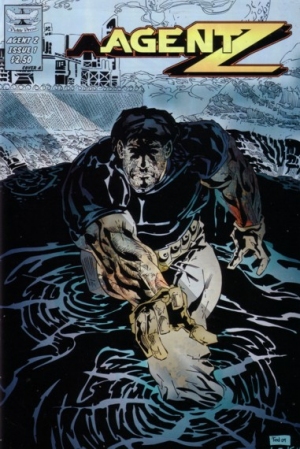
E: Effects and Editing – While maybe not specifically an editing issue per se, I think the seemingly-erratic production schedule to date has to come into play here a little bit. Also as mentioned in the “R” section, the primary focus of the book seems to be the written story, which is excellent in its own right, but as a result the artwork seems to take a back seat. The drawings themselves, done by artist Federico Zumel, are beyond serviceable, especially in the primary cover (shown with this review) and the “alternate” cover featured on my copy. Looking closely at the artwork, I wonder if the printer used to produce the book was less than professional-grade, as I can see the art breaking down into individual dots in places. This didn’t distract me at all or lessen my enjoyment of the book, but I thought it was worth noting here. 5/10

TOTAL SCORE: 6.25/10
VERDICT: A’IGHT

All in all, “Agent Z” is an incredibly intriguing story that I hope is successful enough to live on (pun intended) to see its conclusion in print. If you are interested in picking up a copy of issues #1 and/or 2, please visit http://www.picklepress.net for ordering information.

And now, my friends, you know the Score!

3 Comments

G.O.R.E. Score: Project 9

Project Nine (2010)
Project Nine (2010)

Original Release Date: May 2010 (non-retail)
Run time: 75 minutes

In my never-ending attempts at connecting with and chatting up zombie fans, I get asked the same question over and over and over: “have you seen EVERY zombie movie ever made?”  Unlike a lot of other questions I’m asked that I actually have to take the time to carefully craft a response to, the answer to this query is immediately and adamantly given: no way, no how, sweet Zombie Jesus, no!

Not only are there so many zombie movies out there, from the big-budget Hollywood releases down to the scrape-it-together, cast-and-crew-all-volunteered independent flicks, there are also new stories being produced all the time.  It is, quite simply, impossible for anyone to claim that they’ve seen every zombie movie, because anyone possessing anything short of a god-like omniscience would have no way of even knowing about all the different projects that exist out there.

Fortunately for me as a reviewer, every so often a zombie movie will serendipitously fall into my lap – a film I had no idea existed, and probably never would have known about had someone not reached out and told me about it.  I’m proudly here today to share with you one of those films: Project 9.

Project 9, while having a similar-sounding title but in no way being related to the “classic” Plan 9 from Outer Space, is a unique and ambitious project: it’s cast and crew were entirely comprised of students at the Rochester Institute of Technology (RIT), specifically The School of Film and Animation, along with some select local volunteers.  Created from start to finish in less than a year by a team of over 50 RIT students, the only involvement from school staff (professors and the like) was in an advisory capacity only, making this film truly a “learning experience.”  Written, produced, and co-directed by Dan Sullivan, the film is broken into nine different segments, each part telling a different portion of the tale from start to finish.  Within each segment, a different cast and crew worked to create their part of the story; with nine different directors, nine different editors, seven different cinematographers, and tons of actors and miscellaneous crew, Project 9 takes the meaning of “collaborative film” to a whole new level.

Since Project 9 is such a unique project, I’m going to do things a little out-of-order with this review; I’m going to share some quick thoughts in the Score section on the film as one whole, cohesive unit, and them I’m going to follow it up by sharing a brief breakdown of each individual segment.  So, without further ado, to the Score we go:

G: General Entertainment – The story on the whole is a fairly generalized tale of the zompocalypse: from the initial beginnings of exposure through phases of panic and research, to the eventual decimation of the population, no stone is left unturned in this tale.  However, due to the segmented nature of the film and the relatively short exposure time to each piece of the puzzle, a fair amount of the story gets lost in translation; it takes a keenly-aware viewer who can pick up all the inferences to logically “connect the dots” and enjoy the most complete experience possible. 6/10

O: Original Content – In addition to some intriguing plot points about the genesis of the virus and how the government might choose to counter-attack it, the singular nature of how this film was developed and created immediately skyrockets the Score in this category.  I’m not sure I’ll ever see another movie like this, practically entirely student-run and created not only for love of the craft but also as an extremely educational opportunity. 9/10

R: Realism – While most of the writing and dialogue was solid from section to section, one of the largest detriments to not working with professional actors is that, obviously, on-screen presence and delivery of dialogue will suffer in comparison to what the average viewer gets from an average movie.  The folks on-screen in Project 9 certainly did a serviceable job, but at the end of the day it is an amateur production (and I mean “amateur” in status, not in derogation). 6/10

E: Effects and Editing – Again, since we have students still in “learning mode” taking care of the effects and editing, the quality just can’t be up to par with most films about the undead you’ll pop into your DVD player (although I have seen “professional” productions with far, FAR worse values than Project 9).  For a non-professional project, however, I dare anyone to show me something better than what the RIT crew has given us here.  5/10

TOTAL SCORE: 6.5/10
VERDICT: A’IGHT

Now, as promised, a brief recap of the pros/cons of each individual segment.  Please take the “cons” with a grain of salt, as I am only pointing out certain problems or issues with the hopes of giving any of the RIT students who read this review the opportunity to learn and grow even further from this wonderful project.

Section 1 – The Beginning (directed by Brianna Colleen Byrne): A mysterious person has just proposed that he will essentially turn a fraction of humanity into ‘living zombies’ in order to thin out the population and save the planet’s resources. The world leaders laugh at the idea, until a demonstration is given…”  It’s a very plot-heavy beginning to the tale, but with good reason, as the story must be set-up here.  The camerawork purposefully avoids showing zombies close-up, most likely due to the desire to keep effects budget and screen-time minimal.  The female Corporate CEO’s soliloquies may go on slightly too long, detracting from her realism.  Excellent lighting and sound effects in this section.

Section 2 – Infection (directed byBrendan Nagle): When a disease or contagion sweeps the nation, there is widespread panic, and a mad dash to the hospital. But before people get to the hospitals, the doctors and nurses are vaccinated. What if that was the world’s biggest mistake?”  The hospital setting we are shown here is serviceable, but largely plain.  The camera and sound work when following doctor around home as he succumbs to infection is well-done.  In other spots, though, sound and camera is spotty, a prime example being the extreme amount of camera rotation during the back-and-forth of the two Doctors.

Section 3 – Preparation (directed by Romeal Hogan): Talk to any horror movie fan, and the majority of them will say they have a plan. A plan for when the ZOMBIES come!  Watch and see how putting one of these plans into action may not always be best for those around you.”  The video contrast between first and second cuts in this section is extremely noticeable and somewhat distracting.  The actors in this section come across as unbelievable, and the dialogue seems a little forced.  Nice touch with the inclusion of the main character watching “Night of the Living Dead” on TV.  I also appreciate the inclusion of the deaf child, the usage of American Sign Language (ASL), and the captions given to the viewer, but as someone who has studied ASL in the past, I know that the amount of signing to the child wasn’t quite realistically adequate to convey the information being presented.

Section 4 – Attack (directed by Keri Rommel): What happens when four unsuspecting teens go off into the woods to spend a weekend at a cabin on a lake? Anything, it seems. But these kids have a car and cell phones. Maybe they’ll be all right…”  Probably a little too much cursing here, as it seemed like every third or fourth word was an F-bomb!  Also, it seems like the actors in this segment are standing and waiting to read their next lines, which obviously disconnects the viewer from the realistic feel of the tale.  The high contrast with the inside lights leads to lots of shadows being cast, including one of the boom microphone, oops!  I could have used more realism with the effects in this section; one female gets what should be a rather grisly wound when she is attacked on a bed, and gore should have been shown splattered around, especially on those white bedsheets!  While I liked the premise, I feel that this is the weakest of the sections so far.

Section 5 – Experiment (directed by Adam Schonberg): Of course, the first thing to do when a sickness is taking over the population is to capture a subject and run tests. Regardless of the subject’s well-being, there are some things that must be discovered. Hopefully, there is one person willing to stand up and challenge authority.”  This segment features some odd sound editing; are the musical bursts actually sounds ripped from “Night” or another zombie film, and are they embellished loudly for effect? Initially, I thought the “isolated” shots of Jane, the zombie being experimented on, were a projection of her mentality trapped inside her psyche (she was alone in a dark space and spoke out loud), but that was not the case.  The ending of this piece is designed to be so climactic, I felt that it actually ended up oppositely so when the “big reveal” came.

Section 6 – The Exception (directed by Dan Sullivan): There is an exception to every rule. Dan is that exception. He explains how he’s managed to survive on his own for so long. But even the strongest people have their breaking point, and Dan makes one rash decision after the next. Watch the sad tale of a man in an unfortunate situation.”  Interesting “I Am Legend” feel to this part, although the scene definitely could have benefitted from more emotion in the narration.  I must admit, I’m a little confused by the message the ending was trying to convey; leaving a conclusion open to interpretation runs the risk of your viewer not “getting it” at all.  Or maybe I’m just not as smart as I think. 🙂

Section 7 – Extermination (directed by John Theroux): All hope of saving the infected is lost. It’s a sad realization, but a reality. The military has formed units to go out and hunt these people in order to save what’s left of humanity. But when individuals are given control, sometimes they take it too far.”  This segment features a singular look in this film into the militaristic/mercenary lifestyle.  The sound editing here relies a little too heavily on constant ominous music.  Excellent ending to this portion, leaving the viewer wondering who you are really rooting for.

Section 8 – The Cure (directed by Jason Stoy): There are five working military bases still left in America. And a new plan has emerged that will utilize a new weapon. After the distribution of tainted medicine, the representatives to the people must inform the civilian survivors of the horrifying news.”  An interesting and unique conceit, that of eradicating the first infection by unleashing another.  Unfortunately, a good storyline and above-average acting is bogged down by heavy sound editing and clunky, dark camera work.  This segment may feature the most zombie effects and gore of the entire film, and this aspect of the story is handled very well.

Section 9 – The Result (directed by Jonas Pachuski): The young have become wanderers, living day to day, enjoying some semblance of the return of their lives, and believing that they have outlived the second infection. But life is full of surprises, and Bernie begins comparing his life now to the one he had before everything went wrong, coming to one final conclusion.”  This segment is actually based loosely on a Stephen King short story, Night Surf.”  King has a deal in place with educational institutions called the Dollar Baby Deal, where any student production may adapt and produce one of his short stories for just $1, and that is what was done here.  This segment is interesting from an editing approach of using one continuous and unbroken long-shot, but the effect is muted by characters that we neither know nor care for (and a leading man with a possibly-unintentional case of the sniffles?).  The final moments, while haphazard, put an oddly apropos cap on this singular project.

I have truly had a great time viewing and reviewing this unique film, and I applaud everyone at RIT who was involved with making this project come to life.  As of right now, Project 9 is not available for retail sale, due primarily to legal restrictions with the King short story.  Section 7, “Extermination,” can be viewed in its entirety online by clicking here, and the rest of the film will hopefully be uploaded online at this site soon.  The homepage for the project, where you can see clips and images in addition to learning more, can be found by clicking here.

And now, my friends, you know the Score!

2 Comments

G.O.R.E. Score: Dead Practices

Dead Practices (2010)

Original Release Date: July 14, 2010
Publisher: Sonar4 Productions

We’ve seen zombies put in a variety of situations and scenarios, but have you ever heard of this one: a zombie lawyer?

Putting aside the plethora of lawyer-related jokes that surely spring into your head, author Shells Walter gives us a look into the undead legal system in her novel “Dead Practices.” In the story, set in a world where zombies can be regulated to become high-functioning and productive members of society, lawyer Jerrod is given a difficult task. He is asked to defend Ken Yerns, an off-kilter fellow who thinks he can not only revert zombies back to their “feral” state, but make them do his bidding as well. Turns out he can, and he’s on the loose wreaking havoc with his zombie horde. It falls to Jerrod and his police-officer friend Rusty, with a little help from an eclectic cast of supporting characters, to stop Ken before he goes too far.

I really like the concept of this book: the legal questions surrounding zombie rights vs. basic human rights is an interesting one, and I think the judicial system would be thrown into complete disarray should high-functioning zombies ever appear in our society as it stands now. Unfortunately, I felt that with the story we are presented, Walter misses the mark in this arena. She chooses not to tackle any of these types of questions too heavily, instead putting Jerrod and Rusty into a “whodunit” type of mystery-solving story mixed with a slapstick/buddy-cop comedy undertone. The result is still an interesting tale, but not quite the insightful look into undead law and lawyer-ing that I was hoping for.

It’s also worth noting, in the interest of full disclosure: this is the second book published by Sonar4 Productions that has been reviewed by The G.O.R.E. Score, the first being “The Blooming” by Tonia Brown. In reading that tale, I discovered that the novel was actually more of a novella, coming in around 30,000 words, and some generous formatting on behalf of the publisher made the book appear longer than it actually was. It’s the same story here: making a quick estimation based on words per page multiplied by actual page number, it appears that “Dead Practices” is only about 26,000-27,000 words in length, making it more novella than novel. This is not necessarily a bad thing, as many stories I’ve read are pumped up with unnecessary “filler” text to help it reach the 40,000-plus words you normally see in a novel; I simply want to make potential readers aware of what you’re getting here.

All right – since the book didn’t make this joke, I suppose I must: let’s exercise our power of habeas corpse-us to overrule any objections to the Score:

G: General Entertainment – While the story could definitely benefit from some higher-level editing (more on this below), as it stands now the tale is a quick and fun read of zombie action without a whole lot of mayhem. It’s a lighthearted approach to zombies being integrated into society; a similar take on the undead can be found in the film “Fido.” Walter’s ability to have fun with the story clearly shines through. 7/10

O: Original Content – This is the only story quite of its kind that I’m familiar with. While other tales have certainly used the idea of having zombies function as (semi-)useful members of society, “Dead Practices” is the first I know of to employ an undead lead character as a lawyer. I do have to subtract a few points for the lawyer not doing as much lawyer-ing as I’d hoped, although the “crime/mystery” aspect of the story seems to work well in the absence of a legal thriller. 8/10

R: Realism – This is my biggest problem with the story as it stands now, and probably something a professional editor should have helped fix. The interactions between characters, even though they are entertaining and quite humorous, at many times feel forced and unnatural. While the action and situations seem pretty well grounded in reality, the tale does lean on the element of convenience a little too much: the zombie horde just happens to avoid police detection even though they often attack in broad daylight, and the President of the United States (and his very skimpy Secret Service protection) just happens to be visiting a town with a well-documented feral zombie outbreak in progress. Missed opportunities like these throw a wrench into the overall enjoyment of the book. 4/10

E: Effects and Editing – While Walter has definitely created a great core of a story, it feels like the folks at Sonar4 really didn’t invest the time and resources necessary to help give the book the total-professional treatment it deserves. As mentioned above, the pages are generously formatted with white space, most likely done to give the reader the impression that the story is longer than it actually is. Grammatical and syntax errors are present, although for me these were more of an annoyance and didn’t detract from my overall enjoyment of the story. The cover is serviceable, but the image presented seems largely unattached to the story that exists inside the book. 3/10

TOTAL SCORE: 5.5/10
VERDICT: A’IGHT

When it’s all said and done, Walter has created a fun and unique story that can provide a nice escape from the “usual” zombie fare out there. If you’re looking for something different and don’t mind schlepping through some formatting issues, “Dead Practices” could easily earn a spot in your jury.

And now, my friends, you know the Score!

4 Comments

G.O.R.E. Score: Dreadfully Ever After

Dreadfully Ever After (2011)

Dreadfully Ever After (2011)

Release Date: March 22, 2011
Publisher: Quirk Classics

 In a special feature here at The G.O.R.E. Score, we’ve spent the last week reviewing a trio of undead books inspired by the works of Jane Austen. Called “Austen’s Autopsies,” the reviews are culminating here, in a review of the brand-spankin’-new book “Dreadfully Ever After,” to be released by Quirk Classics on the same day we are be reviewing it, Tuesday March 22! Let’s begin Part 3 of the Autopsy.

Everybody loves a good trilogy.

The thing is, trilogies normally follow a very specific order: first we get Part 1, which is the beginning of the story and the introduction to the characters. Then along comes Part 2, which puts the characters we met in Part 1 in another story, usually adding in some new characters and scenarios to help us feel like we’re getting something that’s the same but also different. Part 3 then wraps things up, often providing a very “final” ending to the story arc or arcs our characters have gone through. Much like most self-contained stories have a beginning, a middle, and an ending, the same formula works very well for trilogies; it’s the reason why everyone from George Lucas to Meat Loaf to J.R.R. Tolkein have seen their best successes come in the form of the trilogy.

But what happens when a trilogy is presented out of chronological order? That’s where the term “prequel” was coined: a pre-existing part of a story is presented as a follow-up se-quel to a tale already released. Pre-quel – a little unorthodox, to be sure, but it happens. In particular, movies like to utilize the tactic of prequels, as it’s an effective way to provide an audience with deeper exposition of a character or storyline without contradicting the original ending to the tale that’s already in place. I know I’ve already mentioned him in the previous review, but talk to the aforementioned Mr. Lucas about this stuff – he likes prequels so much, he made a trio of them! A pre-trilogy trilogy, if you will, and I’m surprised he didn’t try to coin a new term for it: if he had asked, would anyone have starting calling his films a “prilogy?”

But here’s the thing about prequels: they usually stand alone, or are the end of the story-telling avenue for most projects. After all, once you’ve made the conscious decision to go backwards, why completely shift gears and decide to go forwards again? If you wanted to go forward in time with the story, why not just have done so in the first place? So it’s a particular surprise that Quirk Books decided to follow up their “Pride and Prejudice and Zombies” prequel tale “Dawn of the Dreadfuls” with a sequel to the first book, entitled “Dreadfully Ever After.” They’ve essentially made their trilogy go in the following release order: Part 2, Part 1, Part 3. How much sense does that make?

I’ve got to tell you, though: thank the undead gods they decided to come back and release Part 3 in the form of “Dreadfully Ever After.” Because it’s flippin’ genius.

Letting “Dawn” stand on its own as the prequel, “Dreadfully” picks up years after “P&P&Z” concluded with the marriage of the main characters from Jane Austen’s original story, Elizabeth Bennet and Fitzwilliam Darcy. (Quick aside here: I wish “Fitz-“ was still a cool precursor to a first name. I would love to be Fiztzanthony Schaab. Ah, a man can dream…) Anywho, after a few years of matrimony, Elizabeth finds herself becoming morose, likely due to the fact that “proper” married ladies aren’t allowed to fight the “unmentionable” undead, as the eldest Bennet daughter so used to love to do. Before the couple can have a serious heart-to-heart about her feelings, however, Darcy is surprisingly attacked by a young Dreadful monster, and his transformation into one of “the stricken” begins. Elizabeth, ever the lovng wife, can’t bring herself to behead and burn her beloved (as any good Brit living in this alt-history Regency England knows to do), but instead is fatefully reunited with her family on a hasty quest to London in search of a rumored serum that can reverse the effects of this disease known as “The Troubles.”

Let’s fairy-tale our way into the Score so we can put a cap on this entertaining-yet-slightly-askew trilogy:

G: General Entertainment – Steve Hockensmith authored this book, as he did with the prequel “Dawn.” It’s important to note that our dear Fitzsteve had to work within certain confines for the prequel, as he was responsible for ensuring that his tale had the characters and scenarios “make sense” while staying within the boundaries of where the plot had to go in order to connect with the beginning of “P&P&Z.” In this volume, however, he had no such limitations, and his artistic creative freedom rings loud and clear. The story revels in the juxtaposition of gory zombie dismemberment interspersed with the characters’ near-obsessive desire to maintain their high-society prim and properness. The humor of the story switches easily and effectively from subtle commentary to rollicking slapstick to ingenious wordplay without missing a beat. My complaints are so minimal, they are not even worth noting. It is a truly a drop-dead (and then reanimate) enjoyable book from start to finish. 9/10

O: Original Content – Where “P&P&Z” scored a 9 in this category for being one of the true spearheads of the zombie mash-up, “Dawn” dropped to a 6 here simply due to its nature of having to be implanted in an pre-existing universe. While “Dreadfully” obviously exists in the same narrative realm, it scores slightly higher due to some inventive additions to this ZombAusten realm. Notable are ideas like zombie races (think horse races where zombies are the horses and a human is the “rabbit” they are chasing); a “sectioned” London that utilizes its high walls not only for undead defense but also conveniently for class segregation; and the profoundly quirky character Mr. Quayle, a quadriplegic who spends his time inside of a shiny black box on wheels that is pulled by two dogs who have been taught to do everything. And I mean just about everything. 7/10

R: Realism – As the story of the undead menace continues to permeate 18th-Century England, the reader can almost feel the underlying tension in the population that comes with having their everyday lives threatened so insistently. While the premise is obviously not wholly believable, Hockensmith has done an excellent job (in both of his entries into this series) of making you feel like this is less an alternate-reality take on history and more like something that has actually happened. 8/10

E: Effects and Editing – Coming in just shy of 300 pages, this book continues the fortunate turn of not presenting the tale in the “Olde English” style that was contemporary when Austen wrote her original tale, but is  sorely outdated now. Once the Bennets embark on their quest for the serum, the book deftly switches perspectives in alternating chapters, flipping between the family’s exploits in London and the ever-zombifying Darcy’s trials and tribulations back at the Pemberly estate. The wonderful black-and-white illustrations continue to make their appearance here, as they have in the other two books of the series, and the cover of the tome is once again a zombified version of an already-existing classic painting. In my being familiar with some other reviewer’s thoughts, it seems that Hockensmith’s choice to portray Scottish character Sir Angus MacFarquhar’s thick accent so pronounced in the writing was a polarizing one; indeed, MacFarquhar does spend much of the book portraying his brogue in print with words spelled out like “dorrrknob” and “perrrmit.” It’s an interesting choice, but no more unexpected than if a Canadian character would have his speech printed as “oot and aboot.” It wasn’t a huge deal for me as I read, and I hope it won’t be for you either. 8/10

TOTAL SCORE: 8/10
VERDICT: SWEET

When it’s all said and done, the third (and final?) installment of the “Pride and Prejudice and Zombies” trilogy is, in my opinion, the true high point of the series. Combining action, comedy, adventure, social satire, the undead, and yes, even a little bit of romance, “Dreadfully Ever After” is a more-than-fitting send-off to an all-around well-executed zombie mash-up series.

And now, my friends, you know the Score!

1 Comment

G.O.R.E. Score: Dawn of the Dreadfuls

Dawn of the Deadfuls (2010)

Dawn of the Deadfuls (2010)

Release Date: March 23, 2010
Publisher: Quirk Classics

In a special feature here at The G.O.R.E. Score, we’re going to spend the next week reviewing a trio of undead books inspired by the works of Jane Austen. Called “Austen’s Autopsies,” the reviews will culminate in a review of the brand-spankin’-new book “Dreadfully Ever After,” to be released by Quirk Classics on the same day we will be reviewing it, Tuesday March 22! Let’s begin Part 2 of the Autopsy.

Some advance notice for folks who have read “Pride and Prejudice and Zombies” who are looking for the same experience duplicated in Steve Hockensmith’s prequel novel, “Dawn of the Dreadfuls:” you won’t find quite what you’re looking for here.

And that’s not necessarily a bad thing.

“Dawn of the Dreadfuls” is connected to the original Jane Austen/Seth Grahame-Smith mash-up in storyline and name only. The technical full title of this book is actually “Pride and Prejudice and Zombies: Dawn of the Dreadfuls,” in an attempt to make sure readers know the two are connected; far too long of a title for me to type in for the rest of the review, so “DotD” will do from here on out. The plot of this story also utilizes Austen’s classic characters and settings, with the universe slightly expanded to accommodate the prequel-nature of the tale.

Taking place half a decade before the events told in “P&P&Z,” the story opens with the re-appearance of the zombie plague, aka “The Troubles,” that has plagued this world for quite some time but was thought to have been eradicated. Mr. Bennet, father of main character Elizabeth and her four sisters, sees this opportunity as both his patriotic and fatherly duty to pass on his extensive knowledge of zombie-slaying to his daughters. Much to chagrin of his wife – who wants nothing more than to see her daughters happily (and wealthily) married so she can have the attention and good-mothering accolades she deserves – Bennet transforms the family greenhouse into a dojo and engages the instructional services of Japanese martial arts expert Master Hawksworth. Since the “P&P&Z” series would be nothing without a little high-society romance, Hawksworth soon finds himself vying for the affections of Elizabeth, competing against an odd contender in local scientist Dr. Keckilpenny, who believes his research could help domesticate the titular “dreadfuls.” Research is done, emotions are explored, the undead attack, and the story works itself to a satisfying conclusion that sets the stage nicely for the already-occurred transition into Austen’s altered account.

At the risk of sounding too “18th Century,” let us sojourn into yon Score so that I might enlighten thee further:

G: General Entertainment – I’m the first to admit that I was unsure how this story would work when I initially sat down to read it; creating a prequel story to an already-existing tale, especially one that is well-known, is a definite challenge, the results of which won’t always please everyone. Just ask George Lucas about his three “Star Wars” prequel films: it’s a tough assignment, because you have to bring the existing characters to a conclusion that is largely already foretold in the original story. It’s like working through a maze: you know where the end is, you just have to figure out how to get there within the confines of the puzzle. Fortunately, Hockensmith seems to have done his homework, not only utilizing the existing Austen characters very effectively (and managing to use plot devices in “DotD” to establish and explain some of the specific character traits they exhibit in “P&P&Z”) but also creating new characters and reasonably dispatching them within this self-contained plot. Well done. 8/10

O: Original Content – A split vote here. Since the main characters, locations, and general plot situation were all previously established, the opportunity for unique content was fairly minimal to begin with. However, Hockensmith does do a good job of not just expanding the “P&P&Z” storyline, but also elaborating on it, giving fans of this alternate universe even more to enjoy. The addition of the “scientific” aspects of the story, even if Keckilpenny and his captured zombie test subject “Mr. Smith” are a little Dr.-Logan-and-Bub-esque, is a nice supplement as well. So, we’ll meet in the middle area here. 6/10

R: Realism – Much like in Austen and Grahame-Smith’s tale, this story feels largely like it could be taking place in the then-contemporary moment. I don’t really have much else to say in this area that I didn’t cover previously in the “P&P&Z” review, so I’m going to give “DotD” an identical score for matching the relatively-reasonable feel. 7/10

E: Effects and Editing – Perhaps the biggest positive this book has going for it in relation to the previous novel is that “DotD” is written in a contemporary style and tone, instead of looking to re-create the “Olde English” style of Austen’s work in which Grahame-Smith also presented his writings. It made sense for Grahame-Smith to do so, as he was taking Austen’s existing literary work and adding to it; here, in a book that is its own entity, it would have been a dire mistake to try and replicate that style, so kudos to Hockensmith and Quirk for giving us a story that reads “normally” by current standards. Also appreciated is the attention to detail in the continuity of this book’s cover employing a similar style to that of “P&P&Z’s” cover, as well as the continued usage of stylized illustrations throughout the book’s pages. 8/10

TOTAL SCORE: 7.25/10
VERDICT: A’IGHT

While falling just short of a “must-read” status, it’s easy to see why “Dawn of the Dreadfuls” has earned a New York Times best-seller status: it’s a fun, easy-to-read tale that expands on the twisted version of Austen’s classic tale without taking anything away from what has come before it. Fans of “Pride and Prejudice” and “Pride and Prejudice and Zombies” should find much to enjoy here.

And now, my friends, you know the Score!

1 Comment

G.O.R.E. Score: Pride and Prejudice and Zombies

Pride and Prejudice and Zombies (2009)

Release Date: March 1, 2009
Publisher: Quirk Classics

In a special feature here at The G.O.R.E. Score, we’re going to spend the next week reviewing a trio of undead books inspired by the works of Jane Austen. Called “Austen’s Autopsies,” the reviews will culminate in a review of the brand-spankin’-new book “Dreadfully Ever After,” to be released by Quirk Classics on the same day we will be reviewing it, Tuesday March 22! Let’s begin Part 1 of the autopsy.

There are a lot of “zombie mash-ups” out there these days.

For those that may be unfamiliar, “zombie mash-ups” are a trend that started a few years ago, when someone takes a classic or pre-existing archetype and inserts zombies into it. Authors and filmmakers have “mashed” a wide variety of genres and characters with zombies. Some of the genres we’ve seen zombies dropped in include Westerns, Sci-Fi, Romance, Anime, and even Porn (!); zombies have been inserted into superhero comic books and re-written stories about fairy tales, The Wizard of Oz, War of the Worlds, Robin Hood, Alice in Wonderland, and Huckleberry Finn. Even The Beatles have recently received the “zombie mash” treatment.

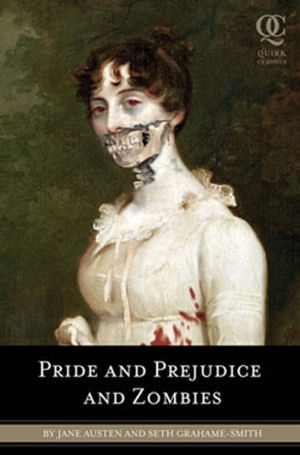
But the mash-up that really brought attention to this unique style of storytelling and really started the full-blown popularity of this trend is easily identifiable. Seth Grahame-Smith took Jane Austen’s classic 1813 novel, give it a liberal sprinkling of our favorite monsters, and “Pride and Prejudice and Zombies” was born.

According to an interview with Time magazine, Grahame-Smith was given the idea directly from an editor at Quirk Books, Jason Rekulak: “[Rekulak] called me one day, out of the blue, very excitedly, and he said, all I have is this title, and I can’t stop thinking about this title. And he said: Pride and Prejudice and Zombies. For whatever reason, it just struck me as the most brilliant thing I’d ever heard.” He went on to say that the book lent itself very easily to the kind of carnage zombie fans have come to expect: “You have this fiercely independent heroine, you have this dashing heroic gentleman, you have a militia camped out for seemingly no reason whatsoever nearby, and people are always walking here and there and taking carriage rides here and there . . . It was just ripe for gore and senseless violence.”

For those unfamiliar with Austen’s classic story, it’s a tale surrounding the main character, Elizabeth Bennett, the product of prim-and-proper upbringing as the eldest of five daughters of a wealthy landowner in 19th-Century England. The book primarily follows her as she goes through her life dealing with relevant (at the time) issues like upbringing, social status, manners, moral turpitude, education, and marriage. Surprisingly, Grahame-Smith’s re-write of the story keeps much of this in place; both he and Austen are listed as the co-authors of the book, and much of Grahame-Smith’s additions to the story were simply done by inserting his writings directly into Austen’s original work (since the book exists as a “public-domain” title, he and his editors were free to do what they like with the original text without fear of lawsuit or copyright infringement).

All this talk of “mashing” is making me hungry for some potatoes, so let’s get on with the Score:

G: General Entertainment – The book itself is pretty darn entertaining, and you’ll find yourself oddly amused by reading about undead carnage written in the “Olde English” style. That’s right – Grahame-Smith wrote all of his pieces of the story in the old style of writing similar to Austen’s, and the result is so close to flawlessly-seamless that you’ll wonder where Austen’s writing truly ends and Grahame-Smith’s begins. After 319 pages, however, reading such a word-heavy style can start to grate on the average reader. 7/10

O: Original Content – Obviously, we have to give the creators of this mashed-up tale credit for going out on a limb and taking a chance, as when this book was first published the mash-up was neither a common occurrence nor a proven commodity. The book was unique and definitely opened the door for the other slew of zombie-mashed mayhem we have seen recently. The subtle addition of ninjas to the plot definitely doesn’t hurt here either. Plus, I’m not sure any zombie tale, mashed or not, had been set in 19th-Century England before this one, so even more points scored! 9/10

R: Realism – The fact that Austen’s original work was contemporary when she wrote it lends itself to the believability of some of the more “normal” things the characters do. This, in turn, makes the reader feel that it’s a perfectly normal part of the characters’ lives when their carriage is attacked by zombies and the riders have to dutifully get out and fend off the undead scourge. When the characters talk of the “dreadfuls,” you truly feel like the monsters have been a part of their lives indefinitely. 7/10

E: Effects and Editing – As mentioned in “G,” after almost 320 pages of reading the “Olde English” style of writing, I was definitely feeling like I had to work far too hard to mentally make it through this book. In addition, aside from the zombie attacks, nothing really happens in this book – the characters move around, talk to each other, a few get married, but there are no climactic battles or big surprises at the end to give the reader the sense of satisfaction that normally comes with closure of a story. I realize this is how Austen’s original story was, but I hoped that Grahame-Smith may have been able to add a little something extra for us here. 7/10

TOTAL SCORE: 7.5/10
VERDICT: SWEET

I feel confident in calling “Pride and Prejudice and Zombies” a “must-own” for every zombie lover, especially if you like very unique and different spins on your tales of the undead. Both in the original content it gives and the contribution to the genre this novel has made as the “Grandfather of Zombie Mash-Ups,” this is definitely a novel you are going to want to seek out.

And now, my friends, you know the Score!