1 Comment

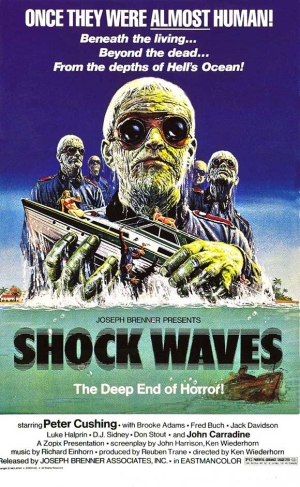
G.O.R.E. Score: Shock Waves

Original Release Date: July 15, 1977
Run Time: 85 minutes

A lot of movie genres have what folks call “sub-genres,” where you can find more specialized types of tales within the greater grouping.  The horror genre is a unique area of film-making, because even the horror sub-genres have sub-genres of their own!  Within the realm of horror films, one of the hottest sub-genres right now is, of course, stories about zombies.  But even within this grouping, many sub-sub-genres exist: you’ve got your zombie comedy, fast-zombie stories, zombie romances, infection-style zombies…the list could go on for quite some time.  In my opinion, one of the quirkiest ones on the list easily has to be the sub-sub-genre for Nazi zombies.  It’s such an odd pairing, like chocolate and oranges or Eminem and Elton John, but always seems to work very well together!

The entrants into this sub-sub-genre are surprisingly plentiful in number: you can easily find films like Dead Snow, Zombie Lake, Night of the Zombies, Horrors of War, Oasis of the Zombies, Outpost, and the list goes on. But we must give credit where credit is due, and there is one film that truly started the Zombie Nazi-sploitation movement: 1977’s Shock Waves. (Some may argue that 1967’s The Frozen Dead was the first, but that film features semi-zombie bio-engineered monsters, at best).

Shock Waves is an enjoyable entry into the zombie universe, even if it is often overlooked by fans or not even known about at all.  In it, Peter Cushing stars as a “retired” Nazi Commander living “mostly” alone on an island off of the coast of Florida.  When a group of shipwrecked divers come ashore and start poking around where they shouldn’t, trouble (for them) ensues.  In a case of either smelling out new prey or just really bad timing, a squad of Nazi Zombies known as The Death Corps, who have been living under the sea for the last few decades, decide to head ashore and partake in some good old-fashioned flesh-eating mayhem.

Let’s goose-step our way into the Score:

G: General Entertainment – The zombies featured in this film are a unique-looking bunch: they are green and scaly, possibly a side-effect of living underwater for so long, and they all wear odd-looking black goggles that obscure their eyes.  In all honesty, the goggles were probably added to the monsters’ get-ups more for practicality than anything else, as the zombies (and the actors who play them) spend a fair amount of time ambling around the ocean floor.  Although it appears that there is an entire squad of at least twenty-plus of the undead, the zombies were actually all played by only eight different actors.  Although they may not look particularly scary in relation to some of the living dead in other films, the scenes of them all slowly rising as one out of the water is quite chilling, and to me is one of the most iconic zombie video moments of all time. 8/10

O: Original Content – Like I said previously, this film was one of the definite forefathers of what has become a very interesting sub-sub-genre, so for that originality I do have to give it credit.  The plot is nothing to write home about – average people get stuck in a situation they never imagined and desperately try to survive it – but the physical presentation of the undead and their singular backstory at the time of the film’s release easily help to boon the Score here. 8/10

R: Realism – As per the usual in many zombie films, the lead characters make questionable decisions throughout the movie.  In addition, it’s highly suspect that a former Nazi Commandant just happens to be hanging out on an island with his team of undead troops ambling aimlessly around the nearby ocean floor for decades without deciding to take off for greener pastures.  In terms of actual acting talent, Shock Waves features a few key names.  The viewer is treated to a definite bonus of Peter Cushing hamming it up with full gusto.  He and co-star John Carradine each worked only four days on the film – Shock Waves took a total of 25 days to shoot – and were each paid $5,000 for their time.  A largely-unknown cast rounded out the rest of the production.  Director Ken Weiderhorn would go on to languish in relative obscurity, helming such forgettable films as Meatballs II and A House in the Hills, although it is worth noting he did direct another zombie film, 1988’s Return of the Living Dead Part II. 6/10

E: Effects and Editing – As mentioned previously, the zombies look pretty darn singularly cool, even if there isn’t much actual gore to be found throughout the film.  Much of the film takes place inside an abandoned hotel on the island, in which Cushing’s SS Commandant has taken up residence.  The hotel featured is an actual Biltmore hotel in Florida; it was shut down for a two-year period and abandoned at the time of filming.  Weiderhorn paid $250 to rent the building for the shoot.  In an amusing twist of fate, the hotel was actually renovated a couple of years after the film shot there, and each room now costs significantly more than $250 per night!  Astute viewers will also notice the wrecked ship used in the background of many sea and shore shots.  In real-life, this vessel is the S.S. Sapona, a concrete-hulled cargo steamer that ran aground near the Bahamian island of Bimini during a hurricane in 1926.  The ship remains at this location to this day, and serves as both a navigational landmark for boaters and as a popular recreational dive site. 7/10

TOTAL SCORE: 7.25/10
VERDICT: A’IGHT

When you get right down to it, Shock Waves doesn’t exactly break any molds or change the face of cinema forever, but it definitely has its place in zombie-movie history.  It’s quite an original take on the genre, with some very interesting ideas being tossed around.  The film is definitely worth a watch, especially to those of you who consider yourselves true zombie fans.

And now, my friends, you know the Score!
1 Comment

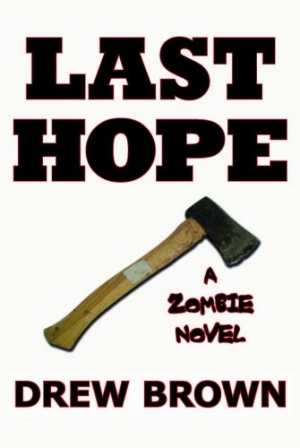
G.O.R.E. Score: Last Hope

Original Release Date: January 1, 2010
Publisher: Apricot Alliance

As a reviewer of “all things zombie,” I see a lot of the same types of stories come across my desk, with a lot of the same archetypes used for the main characters in these tales.   Reluctant hero turned badass with conveniently perfect aim.  Hot girl with no discernible survival skills who somehow manages to survive zompocalypse.  Comic relief guy, most likely obese or minority.  Plucky (read: annoying) kid who retains some form of childlike innocence throughout.  (Insert crappy profession here) with a heart of gold.  Odds are good that you know the “usual suspects” too.

Drew Brown’s novel “Last Hope” features a few of these kinds of characters, but where the tale really scores it’s bonus points with me (aside from the intriguing plot, which we’ll get to momentarily) is in the form of its main character, William “Budd” Ashby.  Budd, quite frankly, comes off as more than a little bit of a jerk; he’s self-centered, cowardly, brash at times, and not much of a leader.  Quite frankly, he’s one of the most realistic “leading men” I’ve ever come across in a zombie novel.

Budd is, to varying degrees, the kind of person the average man/woman would actually be in a situation like a zombie uprising.  To give you a little background on what situation he finds himself in, allow me to give you a brief rundown of “Last Hope’s” plot.  The story itself focuses on Budd and his exploits, starting with his escorting a scientist from a research facility in the Arctic Circle to a fancy hotel in London (Budd is a contract pilot).  As a middle-aged, oft-divorced, loud-mouthed American (USA! USA!) staying in a five-star, full-service hotel overseas, Budd quickly finds himself in many a situation that becomes awkward for everyone else while he remains oblivious to it all.  He finds himself miraculously at a dinner with a young, French pop star named Juliette, and after spending the night with her, he awakens to – you guessed it- the zompocalypse!  The reader quickly realizes, however, that this isn’t your normal zombies-take-over scenario: there’s an odd, heavy fog over everything outside (heavy even by English standards, with visibility at about 15 feet or so), and the undead, who start out as just plain dead, seem to be getting faster and smarter as time goes on.  The last two-thirds of the book are a rollicking ride involving enough action and undead to keep you turning the pages quickly, but it’s the unique elements of where the virus came from and how the zombies continue to act that really set “Last Hope” apart from other, more “standard” zombie tales.

“Rollicking…” that’s a fun word.  I have a strong desire to use it again, so let’s rollick on into the Score:

G: General Entertainment –While the secondary characters in the story are interesting in varying degrees, it is truly the main character that drives this story.  Where you’ll normally get a zombie tale that features the guys who are so testosterone-fueled they can’t wait to shoot, decapitate, or punch their way through the zombies, Budd is very content – scratch that, Budd actually desires to let the others in his group do the fighting while he stays as far away from danger as possible.  I wouldn’t term him an “anti-hero,” per se – he does step up and contribute to the fights when absolutely necessary – but I took great satisfaction in reading him as a kind of older, less-in-shape version of Ashley “Ash” Williams from the original Evil Dead film. 8/10

O: Original Content – Without giving too much away here, I can tell you that Brown effectively weaves elements of horror, suspense, comedy, and a dash of mildly-confusing sci-fi mechanics into this story.  Even though Budd is American, the vast majority of the remainder of the book is decidedly British; while some of the “phraseology” and slang may not perfectly translate to the American reader, it’s very cool to see a “foreign” take on events like these. 9/10

R: Realism – The book does fall into certain “plot gimmicks,” with the characters surviving many more close calls than may be humanly possible.  Yet, things still maintain a fairly grounded feel; give Brown credit for not being afraid to kill of some of the characters the reader has grown to know.  The conclusion – with a final scene that, I’ll be honest, left me a little wanting – is significantly different than the average ending, and I am vastly impressed with the author’s willingness to take a risk and tell it like it’s written. 8/10

E: Effects and Editing – The action and gore are plentiful, with many different types of zombies and ways to kill them prominently featured.  While not written directly in the first-person, the book does follow Budd through the story, with many italicized “asides” in the form of Budd’s actual thoughts sprinkled liberally throughout the book.  The effect is initially a bit jarring, with Budd’s diatribes ranging from one-liners to paragraphs full of “inner monologue” at a time, but it becomes second nature to the story as the novel progresses.  The cover to the book is rather basic, but I appreciate the white cover in a sea of zombie books that feel the need to go for a darker color scheme in an attempt  to match their story’s feel.  The book is long, and the ultimate payoff comes very late in the story, so the “average” reader may lose a bit of steam.  As mentioned in the “O” section, the book is written by a British author, and as such it features much of the English variations that are standard in Great Britain but present as a little “off-kilter” to the average American reader.  Just to give one example, flashlights are referred to as “torches” constantly throughout the book, which is fine; my only complaint here is that Budd, written as an American, should refer to them as flashlights, but he calls them “torches” just like the rest of the cast.  A minor quibble, to be sure, but one that is present throughout the book. 7/10

TOTAL SCORE: 8/10
VERDICT: AWESOME

“Last Hope” is a very distinctive read, an exceptional spin on the zombie genre that you simply will not find anywhere else.  Brown has crafted an excellent story, and I for one look forward to reading what else he has in store for his readers.

And now, my friends, you know the Score!

1 Comment

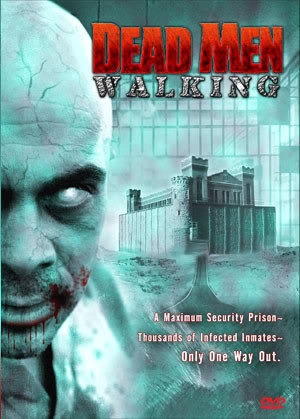
G.O.R.E. Score: Dead Men Walking

Release Date: October 25, 2005
Run Time: 82 minutes

Claustrophobia sucks.

I’ve never been officially diagnosed with the actual phobia, but I’ve got it, at least a low-level version.  I remember it first manifesting way back when I was in Boy Scouts as a young pre-teen; my troop went on a spelunking expedition to a system of caves in southern Indiana, and the realization came at a point where I was wedged into a two-foot-wide space in between two rocks that were hundreds of feet below the surface of the earth.  I said to myself, “Self, why the Hell are we doing this to ourself?  We could get stuck here, with no way out and very little chance of someone coming to save us.  We could get injured…we could starve…we could die.  Who in their right mind finds this kind of thing fun?”

Needless to say, I haven’t been spelunking since.  To this day, I do get a little panicky when I get in certain smaller spaces, usually those that I feel I might have trouble escaping from; being in a small closet that has a door I can open is no big deal, but scooting all the way into the small space under an RV to retrieve a lost ball is another story altogether.  So I feel like I have a special kind of appreciation for the terrible scenario with which most of the characters in Dead Men Walking found themselves facing.

DMW’s premise is actually quite smart, in its simplicity: a “convicted killer” is placed in a maximum-security prison.  The inmate, charged with four counts of murder, was actually defending himself from four zombies, one of whom took a little nibble before being dispatched.  The zombie plague is not widespread yet, and is therefore not of knowledge to the general public.  The infected inmate, of course, quickly turns dead, moving smoothly into undead, and since the prison is under maximum lockdown, the zombie finds himself with a captive smorgasbord as inmates and prison staff fight to stay alive.

You’ve been found guilty – of wanting to know the Score:

G: General Entertainment – Of all the “independent,” a.k.a. smaller-budget, straight-to-video films I have seen so far, this is one of the best.  The writing is fairly solid, most of what happens actually makes sense, and the actors (none of whom I recognize at all) are surprisingly not-terrible.  Does that sentence sound a little too bitter?  I guess I’ve seen enough junk in my day to get really excited when something comes along that doesn’t suck too badly.  DMW is even one step above that, which makes it a pleasant surprise all around. 7/10

O: Original Content – Again, I’m impressed in this category more so than I am with the vast majority of independent films I’ve come across.  Most zombie movies are so concerned with detailing the cause of the beginning of the outbreak and trying to show it go widespread that they forget the fundamentals of a zombie film – be scared that it’s happening, and that you can’t escape it.  Think about George Romero’s original Night of the Living Dead – he didn’t try to show things happening all over the city/country/world, he just focused on the farmhouse.  By setting all of their action inside a locked-down prison, Dead Men Walking eschews the same kind of story.  Who needs to worry about the virus going global when it’s inside the building you can’t escape?  Kudos to writer Mike Watt and director Peter Mervis for using this plot device; they took something old and made it new again.  The final of scene of the movie, while very effective and unexpected, also directly evokes Night, causing me to wonder whether this film was meant as some sort of homage to Romero’s classic. 8/10

R: Realism – We are still dealing with lower-level actors here, and make no mistake: some bad acting and bad lines are present.  But as I’ve said multiple times already in this review: it was an unexpected treat to have this present as well as it did.  While certain lines and parts of scenes come off as wooden or cheesy (depending upon the moment), most of the actors did a very serviceable job of capturing the “realistic panic” of the situation, and there’s a bit of effective comedy thrown in for good measure.  I also appreciated the many different physical and character types of the inmates – they weren’t all Hispanic and black gang-bangers, a stereotype overload.  Using one static setting – the inside of a prison building – allowed the creative team to be frugal yet still factual with the location-dressing budget.  The film was shot on location at the former Lincoln Heights Jail in Los Angeles, now the home of the Bilingual Foundation of the Arts, and it’s an often-used Hollywood filming spot. 6/10

E: Effects and Editing – For a film with an estimated budget of $500,000, it doesn’t look that bad.  My guess is that the vast majority of the money was spent on physical effects, because there are enough zombie kills and zombie killing of humans to please even the most die-hard fan.  Happily, most of the effects were done physically; when the CGI does come with certain head shots, etc., it looks cheap.  As mentioned above, the film is pretty solid in its construction, running just long enough to tell its story without boring viewers with extra nonsense scenes.  The viewer doesn’t get a whole lot of variation in the setting of the tale, but that’s to be expected in a movie where all the action takes place inside one confined building. 6/10

TOTAL SCORE: 6.75/10
VERDICT: A’IGHT

All in all, Dead Men Walking is a nice oasis in the desert of straight-to-video zombie flicks.  It’s available on DVD, and The SyFy Channel seems to have a license with the film’s distributors as well – I’ve seen it in the listings at least twice in the last six months, so keep your eyes peeled.  It’s definitely worth a look-see for the fan that has seen all the “popular” undead films and is looking for something else to satisfy their appetite for destruction.

And now, my friends, you know the Score!

3 Comments

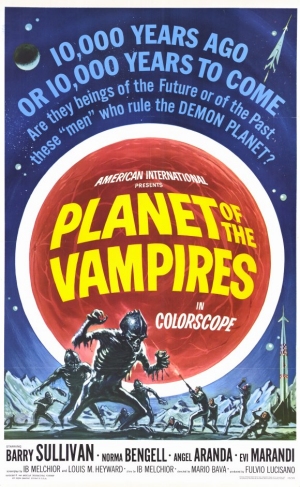
G.O.R.E. Score: Planet of the Vampires

Original Release Date: October 27, 1965
Run Time: 88 minutes

Yes, I realize what the title of this movie is.  No, this site hasn’t changed away from all-zombie reviews.  Yes, I hate the concept of Twilight just as much as you do.  No, this film really isn’t about vampires, but rather creatures that more closely resemble – you guessed it – zombies!  Read on, faithful lover of the undead, for more clarification.

At first glance, Planet of the Vampires could easily be mistaken for just another kitschy ‘60s sci-fi B-movie.  But those “in the know” revere this movie as one of the very first crossover horror/sci-fi films, a front-runner for great movies like Alien and Event Horizon.  Filmed at Cinecittà Studios in Rome, the movie features an international cast and was shot by director Mario Bava on a shoestring budget – but Bava did such a great job of making the film look like a big production that you definitely wouldn’t think otherwise while watching it.

In the film, two large interplanetary exploration ships, the Argos and the Galliott, respond to a distress signal originating from the unexplored planet Aura.  Upon their attempts to land, both crews become possessed by an unknown force and violently try to kill each other; only through the willpower and efforts of Captain Mark Markay, commander of the Argos, is the Argos’ crew prevented from seriously injuring each other.  Upon traversing the treacherous molten terrain of the planet to reach the now-unresponsive Galliott, Argos’ crew discovers that their comrades on the other ship were not as fortunate as they were; they lay strewn about the ship, apparently murdered by one another.

The unknown forces that originally possessed the Argos’ crew return, but instead of occupying the living survivors, the forces inhabit the bodies of the dead crew members, reanimating them from their hastily-constructed graves.  While fending off the reanimated creatures and trying to fix the Argos so they can escape, Markay and the survivors come across a crashed alien ship housing huge skeletal remains of other aliens.  The crew knows their situation is dire, and they are in a race against the clock to escape the force that has inhabited the bodies of their dead comrades.  In a thrilling climax, much is revealed about the true nature of the unknown force, and the movie boasts not one but two inspired plot twists at the conclusion of the film that even I didn’t see coming!

The creation of the film itself has some amazing stories as well.  The production was so pressed for time, the actors – who all came from a variety of international backgrounds – all spoke their lines in their native languages (including English, Portuguese, Italian, and Spanish), often times having no idea what the other actors were saying!  This helps to explain the nagging sensation the viewer will encounter when it seems that some actors’ lines are dubbed into English, causing a disconnect between the actors’ mouth movements and what they are heard to be saying, while others appear in perfect synchronization.

Since the film was so groundbreaking for its time, the studio really had no idea what to name it.  The original Italian title of the film, Terrore Nello Spazio, translates to Terror in Space; other titles attached to the movie in its various stages of pre- and post-production included Planet of Blood, Space Mutants, The Demon Planet, The Haunted Planet, The Outlawed Planet, The Planet of Terror, and The Planet of the Damned.  The confusion/indecision in naming the movie most likely came from the fact that the type of creatures portrayed in the film – reanimated humans possessed by an unknown force – had really never been clearly defined before this movie was released.  Even though the film’s title is Planet of the Vampires, the beings portrayed here are actually closer to zombies, but this film was released in 1965, three years before George Romero’s Night of the Living Dead would adequately characterize this genre for us.

Let’s Score this confusingly-titled film:

G: General Entertainment – This score goes hand-in-hand with the next section, as it is the originality of this film that really makes it a great movie-watching experience.  At the time of its release, there really was no other film quite like it, as no other movie-makers were forward-thinking enough to put a truly scary film into the specifically-plotted confines of a science-fiction film.  Even though the budget was fairly minimal (more on this below), each scene is more suspenseful and engaging than the last, drawing the viewer into the tale in an incredibly effective manner. 9/10

O: Original Content – One scene that Bava didn’t want to skimp on, however, was the sequence where Markay and two other crew members encountered a derelict alien spaceship.  As the astronauts clambered around the large ship, they discovered multiple skeletal remains of gigantic, long-dead alien life forms.  This scene draws immediate comparisons to the extended “space jockey” scene in Ridley Scott’s film Alien, and rightfully so: produced 14 years after Planet of the Vampires, Scott’s scene has a great deal of similarity to and evokes much of the same feel as the one presented in this movie.  Upon Alien’s release in 1979, the horror magazine Cinefantastique ran an article pointing out not only this obvious similarity, but other minor parallels between the two films; both director Scott and screenwriter Dan O’Bannon claimed at the time that they had never seen Planet of the Vampires. 8/10

R: Realism – The movie throws you right into the sci-fi-heavy mix, so there can be a little awkwardness early, depending on how quickly you as the viewer are able to get up to speed.  Once you settle in, however, the interactions between the characters seem incredibly natural, a feat made even more impressive with the knowledge of the actors’ varied international backgrounds.  Both the sci-fi and horror aspects of the plot seem very easy-flowing and not forced upon the viewer, as some films tend to do. 7/10

E: Effects and Editing – As previously mentioned, the film was shot entirely working under a very minimalistic budget; it already looked remarkable (for its time), but Bava’s finished product is even more impressive with this knowledge.  Extensive use of miniatures and “forced perspectives” are used in the film, including tons of colored fog on the planet’s surface to help hide the fact that they were actually just shooting on a bare-bones set.  In an interview with Tim Lucas, Bava expounded on the process: “Do you know what that unknown planet was made of? A couple of plastic rocks — yes, two: one and one! — left over from a mythological movie made at Cinecittà!  To assist the illusion, I filled the set with smoke.”  According to Lucas, the two plastic rocks were multiplied in several shots by mirrors and multiple exposures.  Bava must have been a true master of making do with what he had, because the finished product on screen looks amazingly impressive. 8/10

TOTAL SCORE: 8/10
VERDICT: SWEET

Even without all of this fun background knowledge of the movie, Planet of the Vampires is an incredibly rich story and a great viewing experience that has withstood the test of time and can easily entertain the “true horror fan” of today.  I highly recommend you seek this movie out and give it a watch; you won’t be disappointed.

1 Comment

G.O.R.E. Score: Morgue of the Dead

Original Release Date: February 20, 2010
Publisher:  Lulu.com

“Morgue of the Dead,” the 2010 self-published debut novel from author L.A. Taylor, is an intriguing read, and the book is going to make for an even more intriguing review.  Normally I begin most of my reviews with a side story or some general thoughts on a variety of semi-relevant topics, but with this one, I think I’d like to jump right in and have at it.  So: away we go!

“Morgue of the Dead” (or known by its shortened name as depicted on the cover, “M.D.”) tells a fairly standard beginning-of-the-zompocalypse tale.  Set in the United Kingdom in what appears to be the present day, an experimental agricultural compound is used at a local farm (and in the garden of a bank manager who wheeled-and-dealed his way into getting a bag) in the hopes of eradicating a voracious pest that has been attacking crops.  Wouldn’t you know it, a freak rainstorm pops up (in England?  Say it ain’t so!).  The water lets the pesticide mix with the dead bodies of a local vagrant and the bank manager’s mother, who was conveniently buried in his garden, and they both reanimate.  Throw in some subplots about a bank robbery, some marriages on the rocks, and the aforementioned morgue, and the mayhem is soon officially in full swing.

Let’s hop right into the Score to talk more about this one:

G: General Entertainment – The story itself is a solid one.  Knowledgeable zombie fans will draw immediate parallels between this book and the 1970s film The Living Dead at Manchester Morgue.  Both are set in the United Kingdom, and both involve agricultural aspects as key components in the reanimation of the dead (in the film, it’s a frequency-emitting machine meant to disturb pests that “re-energizes” parts of corpse’s brains).  Heck, they both even share two words in their title, “morgue” and “dead.”  I don’t know if, prior to writing his story, Taylor was familiar with Manchester Morgue (a film I have done in-depth analysis on as one of my “top 25” in my book “Reviews of the Dead: 25 Zombie Movies to Die For”), but the similarities don’t stop the novel’s story form being pretty entertaining in its own right. 7/10

O: Original Content – All perceived similarities aside, Taylor has given this tale enough individuality to stand on its own.  I particularly appreciate the inclusion of the pesticide as the genesis of the reanimation – I’ve always thought that agricultural aspects would seem a likely cause in the event of a zompocalypse, since the industry deals so heavily with chemicals and compounds in the ground, where most corpses lie.  I also enjoyed the small-town setting of the story, as I’ve come across plenty of zombie tales recently that concern themselves with action in bigger cities or on a national/global level. 7/10

R: Realism – My biggest problem in this area was with the characters in the story.  While the characters themselves seemed believable enough, their interactions with one another seemed very “forced,” for lack of a better term.  Many conversations and situations between characters simply didn’t present as very believable.  In addition, many of the characters “talked the same” – they had roughly the same level of vocabulary and no discernible inflections or mannerisms that would help to differentiate to the reader who was actually speaking.  These are issues that could be mostly resolved with a strong re-edit of the book, but as things stand now, the experience was particularly jarring and did knock me out of the story’s “groove” more than once. 5/10

E: Effects and Editing – The book is technically well constructed, but reader beware: the author does a little more “telling” than “showing” in this novel.  Everything in the tale is explained in the narrative very matter-of-factly, including when the zombies start to attack.  Now, don’t get me wrong, the imagery is incredibly effective, it’s just that the style of writing makes things feel very “removed” from the reader’s standpoint.  There is a lot of exposition in the tale – over 50 pages go by before the first zombie makes its appearance.  I noted what I believed to be some editing issues – commas in the wrong places and the like – but this could be more a byproduct of Taylor writing in (for lack of a better term) British-English instead of the American-English that I’m a little more accustomed to. 5/10

TOTAL SCORE: 6/10
VERDICT: A’IGHT

For a self-published work, “Morgue of the Dead” still comes in as an above-average story, and should especially appeal to fans of the classic slow-shambling zombies.  Taylor himself has been in contact with me and informed me that the book is receiving an “upgrade” of sorts very soon: it’s getting a slightly-altered cover and some interior images to help accentuate the story, along with a hardcover release in addition to the paperback.  It sounds like the author is continuing to listen to feedback to tweak his novel and make the experience better for everyone – a humble trait that more authors should strive to achieve!

And now, my friends, you know the Score!

1 Comment

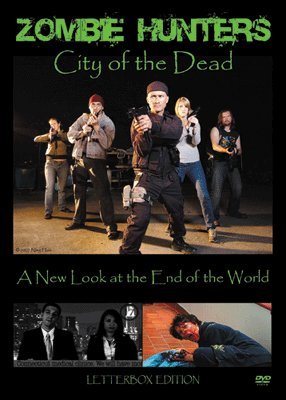
G.O.R.E. Score: Zombie Hunters: City of the Dead

Original Air Date: 2008 (online and local TV)
Run Time: 24-50 minutes per episode (8 episodes)

As a multi-Dead Letter Award winner, I have a special place in my heart for me fellow DLA honorees, both those that also won this year and those that were graced with the honor in previous years.  This year, I was honored to win the awards for Best Non-Fiction Book (for “The G.O.R.E. Score, Vol. 1, available now for only $5!), Best Zombie Website (you’re looking at it), and the Fresh Meat Award for best newcomer to the zombie genre.

So, imagine my delight when I crossed paths at a recent horror convention with my 2009 DLA Fresh Meat Award predecessor, the crew behind the internet-television series Zombie Hunters: City of the Dead.  Specifically, I had the chance to speak in-depth with Christopher Murphy, one of the Producers and stars of the series; it was clear from the get-go that Murphy and the rest of the Zombie Hunters team had created this series not out of an attempt to cash in on the popularity of the genre or anything along those lines; rather, they all seemed motivated by their love of horror – zombies in particular – and their commitment to producing the best independent series they possibly could.  Their passion is refreshing, much appreciated from this reviewer, and is eminently present on their two-DVD set of Season 1 of the show.

The first (and, to date, only) season of Zombie Hunters put a very interesting spin of the very “classic” style of zombie tale.  Taking place as the infection first slowly starts to make its existence known to the world, most of the action follows very regular people as they try to come to grips with exactly what is going on in the world around them.  This infection doesn’t go from non-existent to widespread panic overnight; rather, it slowly builds, leaving many people with little choice but to attempt to go on with their lives as normal (or at least as normally as possible).  A group of acquaintances, mostly guys with very thinly hidden love of guns and mayhem, team together to form a vigilante group with the intent of keeping their neighborhood and loved ones safe.  As situations tend to go in zombie outbreaks, however, the action escalates and things quickly get very chaotic for the group.

Let’s head right on to the Score so I can tell you more:

G: General Entertainment – Make no mistake about it: as mentioned previously, Zombie Hunters: City of the Dead is quite the independent fare.  Quite frankly, it’s some of the best independent stuff I’ve ever come across.  Series Creator and Director (and star!) Patrick Devaney has clearly put an insane amount of personal time and effort into the creation of this series, and it shows.  The average zombie fan, who has been coddled by big-budget Hollywood and their ease of putting very “pretty-looking” films up on the screen, may not appreciate the passion and “by the fans, for the fans” mentality that Zombie Hunters provides; that, of course, is their loss.  True horror fans should be able to take one look at this series and know that, while it may not be the flashiest story around, it feels like a true horror story, and you can never truly go wrong with that. 8/10

O: Original Content – While the over-arching plot of the series so far is your standard “slow zombies are taking over and kinda unstoppable” fare, the high score in this section comes from the series’ attention to detail in slow-rolling the start of the outbreak.  With a nice nod to Night of the Living Dead in the first scene of the first episode, Devaney and company make it clear that the widespread epidemic is still a long ways off, but the journey of getting to that point (or not, if you believe a cure is to be found) is where Zombie Hunters separates itself from other tales. 8/10

R: Realism – The only major drawback to independently-produced fare is that the viewer must understand the low-budget nature of the project.  I’ll speak more to this in the E section, but in terms of reality, the actors and their performances do come into play.  To my knowledge, most if not all of the on-screen talent in this series is working “for the love of the project” (a.k.a. for free); it’s incredibly valiant, and the majority of the main characters do a decent job of creating their personas and sticking with that performance throughout the entire series.  Many of the extras, however, I found a bit lacking in the realism department.  The zombie extras were serviceable enough, but the vast majority of spoken-role “bit parts” left me wanting much more, including (god bless them for trying) the wholly unbelievable newsdesk anchors that popped up far too often for my taste in the first half of the season. 5/10

E: Effects and Editing – On the flip side, Zombie Hunters does a great job of spilling the blood and guts like it’s going out of style, and I loved seeing the various zombie mayhem in all the carnage-filled glory.  There is a copious amount of firearm-shooting, and while I could have done with less CGI-added muzzle fire, I understand why it had to be done for the safety of cast and crew.  The sound editing (particularly music selection) and camera work are far above average for this kind of production, although it does seem like the crew might have been using two distinctly different types of camera, and the result is noticeable via the on-screen resolution from shot to shot – a minor annoyance only. 7/10

TOTAL SCORE: 7/10
VERDICT: A’IGHT

Anyone with a camera and a half-baked idea can go out and film 80 minutes or so worth of footage and call it a “zombie movie.”  Zombie Hunters: City of the Dead gives viewers so much more: in an 8-episode first season, including the final two installments being “super-sized” in length, viewers are given almost five hours worth of story content, and that’s not including some pretty cool deleted scenes and other extras included on the DVDs.  It’s low-budget, independent fare, yes; but it’s independent fare with heart, which makes it some of the finest you can find.

SPECIAL NOTE: Now through July 1, you can get the entire first season on DVD for only $20, and Devarez Films (Zombie Hunters’ production company) is donating all proceeds to a charity fund to help defray medical costs of a little girl who suffered brain trauma and amputation, all before her first birthday.  PLEASE consider visiting the Zombie Hunters website at http://www.zombiehuntershow.com and purchasing the DVDs directly from their store.

And now, my friends, you know the Score!

1 Comment

G.O.R.E. Score: Faith and the Undead

Original Release Date: May 29, 2010
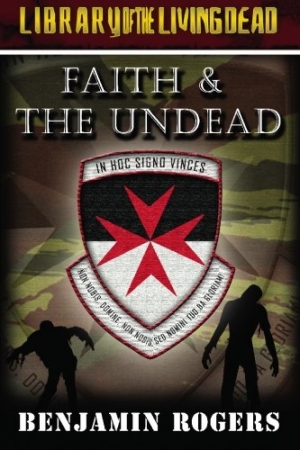
Publisher: Library of the Living Dead Press

It can be a dangerous undertaking to mix religion with – well, with almost anything.  In fact, I know a lot of people and institutions that straight-up refuse to try and introduce anything even remotely religious into any other aspect of their business.  Does the phrase “separation of church and state” ring a bell to anyone?

So it was a welcome change of pace, then, when I saw Benjamin Rogers’ novel “Faith and the Undead” land in my lap.  Most of us are familiar with the iconic quote from George Romero’s Dawn of the Dead of “When there is no more room in Hell, the dead will walk the earth,” but other than a few passing references here and there, most zombie story creators don’t delve too deeply into the spiritual side of the undead.  Rogers tackles the subject head-on, and while the execution of the story-telling falters in some areas and the written results may be polarizing to some readers (based on their own personal faith and belief systems), I found it to be a very intriguing and unique take in a genre becoming more and more crowded with the “same old, same old” type of stories.

The main premise of the story is actually quite brilliant in its simplicity: Satan, feeling that he’s losing the war on Earth between good and evil, uses his powers to create a situation where evil people, after they die, reanimate as his own personal army of the living dead.  God, naturally, is none too pleased about this, so he calls upon some of his oldest and most devout followers: a secret group descended from the Knights Templar, who have been maintaining a ridiculously well-stocked and fortified estate in New England, called The Home.  The compound is currently inhabited by (apparently semi-)retired armed forces members, who are a myriad of nationalities and religions; once the undead start to attack en masse, The Home becomes the last bastion of resistance and the gathering point for helpless civilians.  Both God and Satan have big plans for the Brothers and the Sisters of The Home; the important question, as always, remains: who will triumph in the end?

Give us now our daily Score:

G: General Entertainment – While I found the beginning of the book a little exposition-heavy, once the action started rolling it never let up.  Military fans in particular should feel right at home with this story, as Rogers does a very good job of incorporating not only the equipment and language of the armed forces, but the underlying protocol and values those servicemen and women abide by.  The zombie action was good and – fortunately – the scenes with God and Satan were spread moderately throughout the book, so it didn’t feel that the reader was being beaten over the head with religious overtones. 8/10

O: Original Content – As mentioned previously, in a sea of stories about zombies, not many creators choose to tell their tale about the spiritual aspects, so for this alone I must give a high score here.  Rogers also makes sure that his characters talk in-depth about “faith” versus “religion,” so there are some moments of pretty deep “thinker” ideas rooted in the tale as well. 8/10

R: Realism – Let’s not mince words here: there are a decent amount of fantastical elements to even the most basic zombie story, and when you toss in God, Satan, and a National Treasure-esque secret society that’s hundreds of years old and still somehow a secret, something’s got to give in the reality department.  Overall, I think Rogers juggled all the narrative’s extraordinary elements fairly well, although I must admit I was surprised when the angels had to explain to God what was going on in a certain part of the story – I thought that dude was supposed to be omnipotent and all-knowing? 6/10

E: Effects and Editing – I’m not perfect with grammar, but I do expect a fairly high level of near-perfection in that area from books that are professionally-produced and have gone through what I can only assume are multiple edits by both the author and an editor (or editors).  “Faith and the Undead” is fairly solid in this department, but there are some nagging formatting and syntax issues that bring this category down somewhat.  Rogers and company also chose to employ an interesting approach to each chapter: they began every one with a quote or snippet of story that was out-of-context with what was going on in the rest of the chapter in question.  It’s an interesting thought, but after 37 chapters, I personally felt that the tactic became distracting and unnecessary.  There was even one chapter in the middle of the book that didn’t have the feature at all, which made it all the more of a head-scratcher to me. 5/10

TOTAL SCORE: 6.75/10
VERDICT: A’IGHT

The first part of a planned trilogy, “Faith and the Undead” is a very unique entrant into the zombie genre, but be forewarned: it’s heavy reliance of faith-based and spiritual plot points may be just as much a turn-off to some readers as it is a draw for others.  I was able to look past the editing issues because, in my opinion, Rogers has created a reading experience that can’t be found anywhere else in zombie fiction, and I’m looking forward to the next installment!

And now, my friends, you know the Score!