Leave a comment

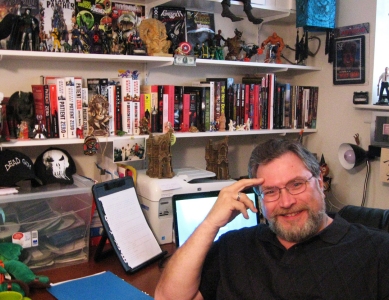
Guest Review: Jonathan Maberry

Guest Review
by Jonathan Maberry

 
Hello all!
 
I’m delighted to be a guest reviewer here on the G.O.R.E. Score.  And thanks to Tony Schaab for the weirdness that is MAY-Berry Month here on the site.  There are some disturbed individuals associated with this site—staff and readers; but luckily various forms of treatment are available.
 
Instead of reviewing a single book (as I was invited and, dare I say, expected to do), I decided to provide my MUST HAVE list for best horror reading and viewing. These are the horror works I feel have great enduring merit and laid the groundwork for the best of today’s creepy storytelling.  It’s not a complete list by any stretch, but for me, all of these are 10/10.  There isn’t a weak one in the bunch.
 
THE HAUNTING OF HILL HOUSE by Shirley Jackson: This was the first truly frightening novel I read, and the original BW movie is still my pick for the scariest horror film ever made.  It’s all about the suspense, not about what jumps out at you.  The remake is to be avoided at all costs.
 
THE LEGEND OF HELL HOUSE by Richard Matheson: This was an attempt to modernize the Shirley Jackson model, and Matheson makes it work. The novel is scary as hell, tapping into the early 1970s vibe still humming from ROSEMARY’S BABY, THE EXORCIST and THE AMITYVILLE HORROR. The movie is a wonderful adaptation of the novel and holds up pretty well all these years later.
 
THE MANITOU by Graham Masterton. Though a little dated (and very often copied) nowadays, this was a deeply disturbing novel with an unexpected theme.  The movie is fun; the book is far superior.  I also recommend DEVILS OF D-DAY and THE WELLS OF HELL.
 
GHOST STORY by Peter Straub. A true American gothic novel. Lush, rococo, and finely crafted; with a killer opening line, a terrific set of villains, and overall superb character development.  And though the movie changed several essential plot points, it is a nail-biter of a classic. Scary and sexy.
 
SALEM’S LOT by Stephen King.  For me this is a perfect horror novel; superior in my view to THE SHINING. It has some of the most terrifying images—seen and alluded to, and King’s most powerful and effective descriptive language.  This is one I return to every few years.
 
THE MIST by Stephen King. Though technical a blend of science fiction and Cthulhu-style fantasy, it is one of King’s masterpieces. My only complaints are that it was too short for my tastes, and he never wrote a sequel.  Damn it.  The movie was damn good and had an even more powerful ending –one of which I thoroughly approve.
 
I AM LEGEND by Richard Matheson: The first true blending of horror with science fiction, and a marvelous piece of social commentary. The essence of the novel’s plot —especially the biting ending—has yet to be translated into film. The Vincent Price version, THE LAST MAN ON EARTH, took a stab at it, but the movie is stultifyingly boring. The Charlton Heston version, THE OMEGA MAN, is cheesy popcorn fun without depth; and though the first half of the Will Smith version had real promise, it collapsed into nonsense in the second half. (My dream project is to do a faithful adaptation of this novel.)  Oh, and Matheson gave me a signed copy of the 1954 edition when I was fourteen.
 
THE RATS, LAIR and DOMAIN by James Herbert. I love this series so much I’ve read multiple copies of it to rags. Absolutely great storytelling with lean prose and a lightning pace.  And…ewwww!
 
RATMAN’S NOTEBOOKS by Stephen Gilbert.  This was the basis for the movie WILLARD (the original was pretty good) and BEN (don’t bother). It’s a psychological thriller about a disintegrating mind that is every bit as chilling as PSYCHO.
 
PSYCHO by Robert Bloch.  Speaking of PSYCHO, the Robert Bloch novel is a lost classic. It informed a generation of slasher and serial killer novels by creating tropes which made other, lesser writers more famous.  Bloch wrote it first and best.
 
THE HOUND OF THE BASKERVILLES by Sir Arthur Conan Doyle.  I had to slip this in because it is also an often-copied model in that it is a straight mystery told in the form of a horror novel.  Often filmed to varying degrees of success.  My personal favorite is the Peter Cushing/Christopher Lee version, but there are many good ones.
 
SOMETHING WICKED THIS WAY COMES by Ray Bradbury. Before there was even a Young Adult genre in fiction, Bradbury crafted a perfect horror-fantasy in which an evil circus (Cooger and Dark’s Pandemonium Shadow Show) comes to town. The same year Matheson gave me a copy of I AM LEGEND, Bradbury gave me a copy of this. I read a copy of this book every year on Halloween.
 
PHANTOMS by Dean R. Koontz.  This is a science fiction novel written as a horror novel. Koontz was never better and seldom anywhere near as scary. Forget the movie and read this on a dark night.
 
MYSTERY WALK by Robert McCammon. This early novel of McCammon’s has gorgeous and unexpected imagery, including a description of the sound a haunted buzz-saw makes that will definitely stay with you.  I came back to this after twenty years and it was every bit as good.


1 Comment

G.O.R.E. Score: Marvel Zombies Return

Marvel Zombies Return (2010)Original Release Date: January 1, 2010 (collected)
Number of Issues: 5
Publisher: Marvel Entertainment

“Marvel Zombies Return” was a mini-series designed to give readers a sense of closure for the story concerning the “original” Marvel Zombies, superheroes from an “alternate” Earth who were stricken by an alien virus and became flesh-munching monsters.  Marvel was also wise to bring in some experience “zombie veteran” writers to each have their hand at writing an issue of this series:

  • the second issue, with a story revolving around Iron Man, was written by David Wellington, author of the “Monster” trilogy of books
  • the third issue, with a story revolving around Wolverine, was written by “Patient Zero” and “Zombie CSU” author Jonathan Maberry
  • the fourth issue, with a story revolving around The Hulk, was written by Seth Grahame-Smith, best known to fans as the “co-author” of “Pride and Prejudice and Zombies”

Fred Van Lente, the writer for the “Marvel Zombies 3” and “Marvel Zombies 4” mini-series, provided the bookend first and fifth issue.

When we last saw these self-aware superhero zombies at the end of “Mrvel Zombies 2” (“MZ3” and “MZ4” followed a storyline of different characters), they were surprised by a small group of living survivors and teleported off of their original home world of Earth, which they had decimated.  The teleportation device used to surprise them had been reconstructed from its original form and the reader was never given an idea of who programmed it or where it was set to send the zombies.  We find out in this mini-series that the zombies were sent to “Earth-Z,” a parallel universe I believe we have never seen before, except the teleporter deposited every zombie in a different location in this universe, and it is apparently the late 1960s on “Earth-Z.”  I’m judging this date by the facts given to us in Issue #1: the story follows zombie Spider-Man as he finds himself witnessing events that took place in his home world some time ago (in issues of Spider-Man comic books first released by Marvel in 1969, according to editors notes).  His actions in this universe lead to – surprise surprise! – some carnage and devastation, and with that, the series is off and running.

Time to give Marvel Zombies the final Score:

G: General Entertainment – This story returns us to the high-enjoyability factor that we haven’t really seen since the original Marvel Zombies went away in “MZ2.”  There is an odd feeling that nagged me throughout the series, but I attribute it to the writers knowing that this was essentially the end of the line for this particular storyline, and whenever creators know that they only have a finite amount of story space left to work with, I do feel that it causes them to sometimes do things a little differently.  The story definitely gave readers a very interesting and satisfying endpoint to the tale, and for that sense of closure that not all comic stories get, I am grateful. 8/10

O: Original Content – Bringing back the original Marvel Zombies makes me smile, and I suspect I’m not the only MZ fan to do so.  We’ll go back to the original score the first mini-series’ got here, since these are the same zombies we know and love from those series. 7/10

R: Realism – A couple of nagging questions here, like why did the zombified heroes get dumped in the late ‘60s and spread across the universe?  Also, when we last saw the zombies in “MZ2,” many of them were working on controlling their hunger, and some had actually achieved control; in this series, the control (and the desire to do so) seems to come and go whenever it’s convenient for the plot line. 6/10

E: Effects and Editing – Each issue in this series got a different artist and a different artistic approach to it, which I think is really inventive.  Kudos to artist Nick Dragotta for a great first issue of this series, as the story really evoked the ‘60s/’70s comic book feel and look.  Writer Fred Van Lente also did a pretty good job with the first issue, although some of the zombie carnage felt a little out of place when paired with the “wholesome” feel of the old-school artwork.  I know I have really written about how displeased I was with Van Lente’s work in “MZ3” and “MZ4,” but perhaps he learned a thing or two about effectively writing a zombie story by working with some of the great zombie writers of our time.  Wellington and Grahame-Smith’s issues were also well written, but I feel that Maberry’s Wolverine-centric issue is really the high point of this series, both in his writing and the accompanying frenetic “sketch-style” artwork (created by Jason Shawn Alexander). 9/10

TOTAL SCORE: 7.5/10
VERDICT: SWEET

When this review was originally released here on the site in June of last year, it was the culmination of an event called “Marvel Zombies Week,” where I reviewed all seven Marvel Zombies mini-series in seven days.  As the review was originally being written, “Marvel Zombies 5” was being released, following the story and characters from “MZ3” and “MZ4,” so who’s to say another Marvel Zombies Week isn’t in our futures, somewhere down the line?  Stay tuned!
And now, my friends, you know the Score!

2 Comments

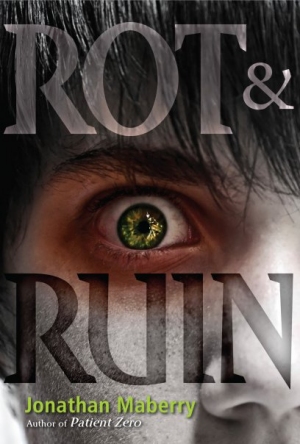
G.O.R.E. Score: Rot & Ruin

Original Release Date: September 14, 2010
Publisher: Simon & Schuster

Kids are funny.

Having had one of my own for the past year-plus now, I am just starting to relate to a lot of the things that parents often say about kids.  While my daughter is still young enough to not engage in some of the more severe bad habits many kids form – talking back, temper tantrums, and the like – I do see her already starting to take on one habit I’m not particularly fond of: when I say “no-no” to her, seriously, in an attempt to get her to stop doing something, she almost assuredly continues to do that exact same thing, as if it’s a game to her!

My point is: it’s a well-established fact that may kids, from an early age well into their teens, will do the opposite of what they are told, and in many cases they’ll do it just because it’s an act of defiance for them.  Parents are usually asking their children to do or to not do something for a very good reason…but that doesn’t matter to the little ones.  All that matters to them is being independent and having some fun.

When you take a book and label it as “Young Adult,” then, you have to be extremely careful, as you are walking a very fine line: you are essentially telling a youngster that the book is specifically for them, which is akin to asking them to read it.  Of course, in classic defiant-child fashion, lots of times young adults will actually refuse to read a book labeled as YA – and it often times boils down to what we were talking to above, they just don’t want to be told what to do.

Clever, then, was the marketing for Jonathan Maberry’s novel “Rot & Ruin.”  It was released in hardback form first, making for a very “adult-feel” book.  The novel itself is huge, clocking in at over 450 pages – granted, the margins are a little wider and the text is a little bit bigger than the average book, but the adroit formatting leads to a book that presents very much as a “big-boy” or “big-girl” novel.  Think of the monstrously-huge Harry Potter novels, and you’ll have an understanding for how this appeals to younger readers.  Finally, and most importantly, you won’t find the words “young adult” anywhere on the book; in a great “hide in plain sight” approach, the book was given a marketing campaign that informed folks it was a YA-appropriate novel without ever coming out and putting it on the cover.

The best part about “Rot & Ruin,” though: the story itself. Maberry has crafted an amazing tale of post-apocalyptic zombie survival, and he struck the perfect balance between making the story accessible and engaging to both younger readers and adults.  The tale is chock-full of unique elements you won’t find in the average tale of the undead apocalypse, and there is a refreshingly-surprising about of “thinker” material mixed in with action, comedy, and emotional scenes.

I can’t possibly summarize the book any better than the oft-used “official” blurb, so I’ll go ahead and quote that before “Rot-ting” right into the Score:

Benny Imura needs a job. He’s fifteen and his rations are going to be cut in half if he doesn’t start contributing to society. Benny isn’t picky. Any job will do as long as it requires minimal effort and doesn’t involve working with his annoying, boring, completely irritating older brother Tom.

But being a locksmith apprentice is boring and involves carrying heavy tools all day. Fence testers have to walk the fence all day rattling it for loose spots that zombies might exploit. It also means possibly getting shot by the twitchy gun bulls because there is a zero-tolerance policy when it comes to infection. There’s too much competition selling carpet coats. Pit thrower is too labor intensive. Not to mention it involves throwing  “quieted” zombies into a burning pit and maybe getting infected. And pit raker, well, pit raker is exactly what it sounds like.

With no better options, Benny finds himself reluctantly apprenticed to his brother Tom, a zombie killer and “closure specialist”–whatever that means. Benny doesn’t really care. At least he can keep his rations and has a job that sounds moderately cool.

But nothing about dealing with his brother, or the zoms, is anything like Benny expected. Out in the “Rot and Ruin,” where the zombies run loose, is different. Nothing is what Benny thought, not his heroes, not his friend Nix and her mother, and certainly not his hometown. Even Tom might be a lot more than Benny ever gave him credit for.

G: General Entertainment – As I mentioned above, Maberry has done a tremendous job of seamlessly blending so many different “feels” to his story – the quality of writing here goes far beyond what normally passes for “young adult.”  I hate to even use that phrase, because I don’t want any adults to feel like they would be “reading down” a level if they grabbed this book, because that is far from the case.  Perhaps saying this book is appropriate for “all ages” might be better; certainly, the story is fantastic enough in its own right that it should be enjoyed by readers of all ages. 9/10

O: Original Content – Mayberry taps into a slowly-developing trend for the setting of his story: it is truly “post-apocalyptic” in the literal sense that the tale takes place 15 years after the zombie outbreak began, and the living-human contingency has clearly lost the battle. I don’t want to ruin your enjoyment of the book by giving too much away here, but just know that there are a plethora of unique elements – including zombie trading cards that fit surprisingly well into the story – that help this book stand out from the crowd. 8/10

R: Realism – Maberry uses emotion as the primary driving force here, and you can feel the very real connections between his characters.  Other reviews I have read criticized this area for the characters not being “relatable enough,” but I found that to be with good reason – since many of the main characters are youngsters born into this world of ruin, they obviously have different personality traits and an outlook on life that we today do not.  They don’t exactly get the luxury of sitting around with their computer tablets while watching a TV show on their DVR and eating their microwaved dinner, so obviously this group isn’t going to seem immediately relatable to the reader.  It’s just one piece of the “reality” puzzle that I think Maberry has constructed quite effectively. 8/10

E: Effects and Editing – As noted above, the book is a big one, but even though it sports 55 chapters (plus an Epilogue that smoothly sets up the sequel) over 458 pages, I read through the book tremendously quickly, and have heard of many other readers who have done the same.  The design of the book itself is solid, with great cover graphics and a visual representation on the inside cover of some of the aforementioned zombie trading cards.  The cards were drawn by artist Rob Sacchetto, whose book “Zombiewood Weekly” was reviewed by the G.O.R.E. Score previously. 8/10

TOTAL SCORE: 8.25/10
VERDICT: SWEET

This is the first novel not written by Max Brooks to Score over an 8 in the history of The G.O.R.E. Score.  “Rot & Ruin” is quite deserving: readers get everything they want out of a good zombie story delivered directly to them, plus many one-of-a-kind elements and a subtext that has the ability to really make you stop and think about the “bigger picture,” not just about this story but about life in general.  Folks, in case you aren’t quite grasping what I’m saying: I highly recommend this book!

And now, my friends, you know the Score!

2 Comments

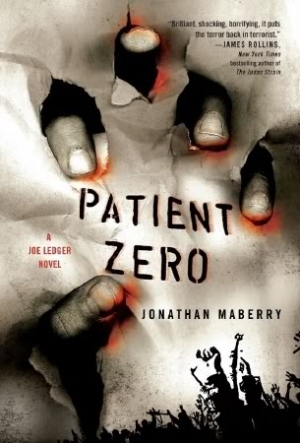
G.O.R.E. Score: Patient Zero

Original Release Date: March 3, 2009
Publisher: St. Martin’s Griffin

A lot of zombie novels in the stores these days present themselves as “standalone” stories; that is, they make it clear through the story-telling process that the story you are reading in that book is all the story you’re going to get, and the ending is so bleak and/or final that you know the author never wants to revisit this particular universe ever again.

Maybe it was just me, but I got the feeling right from the very first pages of “Patient Zero” that this book definitely was NOT going to fall into the aforementioned category.  The fictional star of the book, Joe Ledger, is a stereotypical badass – think of a cross between Star Trek’s Captain Kirk and Mission Impossible’s Ethan Hawke, with a dash of Marvel Comics’ The Punisher thrown in for good measure – but the man and the situations he gets into are so much fun, he easily becomes much more an enjoyable character instead of slipping into the realm of just another caricature.

In Jonathan Maberry’s “Patient Zero,” Ledger quickly transforms (at first rather unwillingly) from an uncompromising Baltimore detective to something much more when he is “recruited” by the FBI to lead a new, secret government agency called the Department of Military Science (DMS).  Ledger thinks he’s seen it all in his detective work, but he discovers that he is sorely mistaken: certain countries’ anti-U.S. sentiment has combined with overseas corporate capitalism to lead a group of terrorists into creating a new form of biological weapon.  This weapon, which effectively turns good folks into bloodthirsty zombies, will be unleashed on the unsuspecting American population.  In typical “save the world” fashion, it’s up to Ledger and the DMS to stop it all from going down.

Let’s “Zero” in on the Score:

G: General Entertainment – While it sports a lot of fun elements, the book itself draws heavily on a lot of established action/adventure tropes to establish the basis of the story: bad-ass cops and the impossibly-hot women they encounter, insane action scenes where the good guys emerge incredulously unscathed, biological weapons from the big-bad foreign threat, and the undead, of course.  The fact of the matter is, though, that Maberry has very effectively blended all these elements together in a rollicking, B-movie type of experience, and it’s damn near impossible for the average reader to do anything but just sit back and enjoy the ride. 8/10

O: Original Content – As mentioned above, the book does utilize elements of many different types of genre stories that have come before it.  However, I definitely give credit to Maberry for not only adding his own unique pieces where he could (namely, the singular character that Ledger becomes and the nuances of the top-secret DMS) but also the exceptional blending of the genres to create a great story.  When someone writes a tale of horror, action, suspense, thriller, and new-wave/techno stylings, that someone better have a great ability to successfully tell a story and keep the reader feeling like everything is fresh.  Fortunately, “Patient Zero” has that someone.  6/10

R: Realism – When you have a tale that mixes and matches so many fantastical pieces of the puzzle, the realistic boundaries obviously have to be taken with a slight grain of salt.  Most of the characters, from the DMS team members to the evil foreign terrorists to the model-level-hot token females (on both the good and the evil sides, me-ow), have more than a few moments of utter cliché.  Surprisingly, however, much of the technological and medical/biological aspects of “Patient Zero” felt relatively grounded in real-life.  Indeed, Maberry made sure to point out in his “Author’s Note” at the beginning of the book that he did a great amount of research and consultation with medical and tactical professionals to ensure that this aspect stayed as true to reality as possible.  It’s a welcome touch to such a fantastic story. 7/10

E: Effects and Editing – Clocking in at close to 420 pages, readers are definitely getting their money’s worth here, although the size and interior configuration might give a casual reader pause.  The story is broken up into a mind-bending 125 chapters, with some of them being as small as one paragraph, and the tale is capped off with a 5-point Epilogue to help set up the next book in the series, “The Dragon Factory.”  I personally really liked this unique set-up, but I could see how someone who isn’t an avid reader could get frustrated when they look up in the middle of the story and see that they were “only” on Chapter 80. 7/10

TOTAL SCORE: 7/10
VERDICT: A’IGHT

While “Patient Zero” may not be in all readers’ wheelhouses, it’s a tremendously enjoyable story from start to finish, and one that I definitely recommend to zombie fans who don’t mind a bit of “action movie” seeping into their undead tales.  With Maberry recently mentioning to me that he is putting the finishing touches on the fourth Joe Ledger novel, “Patient Zero” is a great foundation for what has clearly become a beloved storyline to fans, and one that is (fortunately) not going away anytime soon.

And now, my friends, you know the Score!

3 Comments

G.O.R.E. Score: Marvel Universe vs. The Punisher

Released: 2010
Publisher: Marvel Entertainment
Format: 4-issue mini-series; collected graphic novel

Even though it seems like so long ago, at one time I was a bright-eyed, fresh-faced lad of 16 who was out looking for his first job. Call it fate, Karma, or just plain dumb luck, but I chanced my way into getting hired on at a comic book shop, an action that would cement my love of fantastical fiction and pave the way for my addiction to horror as well.

From the very beginning, I found one comic character in particular that I was quite enamored with. While so many other characters were granted super-powers or mutated into something that allowed them to be greater than the average person, there was always one hero in particular who not only was a non-superpowered being, but was also a very conflicted man and driven by the most intriguing of human emotions: revenge.

See, the bad guys killed his family, but they didn’t do it on purpose. He was a decorated American soldier and a genuinely good guy, but one fateful day when he took his wife and children to the park for a picnic, they were caught in crossfire between two rival gangs, and only he survived. As he recuperated in the hospital, he took his sadness, rage, and anguish and compressed it all into a vow to his departed family: he would spend the rest of his life mercilessly punishing the guilty.

Thus Frank Castle became The Punisher, one of the most feared and misunderstood vigilante heroes of our time.

Frank has been around the Marvel Comics Universe since the late 1970s, first appearing in the pages of “The Amazing Spider-Man” and immediately captivating viewers. In the 30-plus years since, he’s brought a plethora of bad guys to justice and has seen an impressively wide variety of action and storylines. I think my favorite – and this is no joke – is when he went to the sleepy town of Riverdale to track a mob boss that bears an uncanny resemblance to a certain red-headed, all-American teenager…that’s right, it was a “The Punisher vs. Archie” crossover spectacular!

But we’re not here to talk about Frank’s various other exploits, we’re here to discuss one of his recent mini-series, titled “Marvel Universe vs. The Punisher.” (If you’re wondering why the title wasn’t “The Punisher vs. the Marvel Universe,” it’s because that storyline has already been done back in the late ‘90s, with the too-similar sounding title “The Punisher Kills the Marvel Universe.” I told you, Frank gets around!)

This series was written by veteran zombie/horror guru Jonathan Maberry, who makes it very clear in the story that he has a great understanding of Frank’s history. In this tale, Frank accidentally unleashes a bio-engineered virus while trying to stop some bad guys; he gets an up-close experience with the virus in its liquid form, and this “super-dose” gives him the immunity that the rest of the world doesn’t receive. The virus quickly turns the entire population of the world, super-heroes and regular folk alike, into crazed monsters who revert to their most basic urges of aggression and sustenance – cannibals. While a small amount of random people seem to have a natural immunity, the entire world succumbs very quickly, and when superhero cannibals start to form tribes and attack anyone and everyone they encounter, it’s up to The Punisher to do what he does best: discipline the evil.

Let’s get into the Score so I can give you some info on this series:

G: General Entertainment – The series sports a very “I Am Legend”-esque type of feel to it, while still making the storyline its own. The book looks great, from the post-apocalyptic-style covers to the dark and brooding interior sequences. Credit Maberry for creating a fun tale that really gives The Punisher the freedom to do what he does best. The conclusion of the tale is great as well, and it really adheres to the principles that The Punisher holds true, instead of going for a typical “happy” ending. 8/10

O: Original Content – Maberry and I have actually had a brief discussion about how the creatures featured in this tale aren’t seen as zombies by use of the “general” definition, and I don’t dispute that. However, if you are familiar with the guidelines of what exactly makes a zombie for the purposes of The G.O.R.E. Score treatment (the definition of which is readily available for you to read in the first pages of “The G.O.R.E. Score, Volumes 1 and 2,” ah thank you), this story fits squarely in my target zone. Indeed, at the very beginning of the story a newsanchor asks a scientist if the people suffering from the disease are akin to the afflicted folks in the film “28 Days Later.” This is the first time a Rage-type virus is shown impacting the entire Marvel Universe – heroes, villains, and civilians alike – so the originality content is obviously fairly high here. 7/10

R: Realism – The series definitely retains much of the feel of what an utterly destroyed society would look and feel like years later, even if some minor suspension of belief is required from the standpoint of the super-powered beings. For some folks unfamiliar with the Marvel characters, there may be some initial confusion in the tale in regards to what exactly it takes to kill someone affected by the virus; certain characters are shown being killed with one gunshot to the head/chest but others can be chopped up into bits and still come back to life. Remember that even though many of these characters are suffering from the virus, they still retain their super-powers; this is the case with the oft-killed and oft-reanimating Deadpool, whose mutant power makes him incredibly difficult to permanently destroy, despite Frank’s repeated attempts. 7/10

E: Effects and Editing – The series sports a really fun style of artwork, utilizing a quirky look that I might best describe as a mix between current comic drawing and the “retro” blocky-style of atwork. Credit series artist Goran Parlov for the fun visuals. The story flows pretty smoothly, even using some effective flashback sequences towards the end of the series to remind the reader about not only what has happened earlier in the tale but also information about The Punisher’s pre-vigilante life – we see Frank’s family’s death for the umpteenth time in his history, but it still looks good. 8/10

TOTAL SCORE: 7.5/10
VERDICT: SWEET

While not your “usual” zombie fare, this is still a great story that most folks should be able to easily enjoy. I may be letting my “fanboy” nature into my review, but folks who are especially familiar with the Marvel Universe will get an added level of enjoyment out of seeing so many superheroes and villains in a very new and unique situation.

And now, my friends, you know the Score!

1 Comment

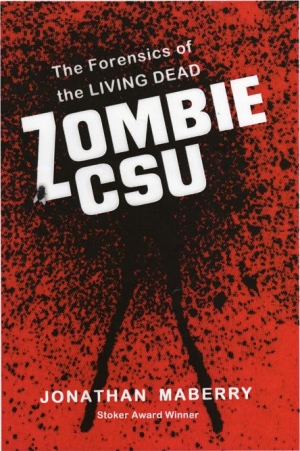
G.O.R.E. Score: Zombie CSU

Zombie CSU
Zombie CSU (2008)

Original Release Date: September 1, 2008
Publisher: Citadel

2008 doesn’t seem like that long ago. Yet in the world we live in, one of instant gratification, media-on-demand, technology that’s outdated by the time it hits the shelves, and a constant worldwide demand for the “next big thing” to be and better and grander in scope than anything that has come before, you’d better believe that three years is an eternity in the entertainment industry.

That’s why I was shocked, truly shocked, to recently have cracked open my copy of “Zombie CSU,” the first Jonathan Maberry book I ever owned, and see printed on the “legal” page that this book was first printed in 2008. It feels like I’ve had this book for 10 years and must have read it at least as many times. I guess it just goes to show that even your friendly neighborhood horror critic loses track of some of the more important statistics sometimes!

“Zombie CSU” is a meaty book, filled with a copious amount of information about zombies, their history, the scientific aspects of their condition, the legal and psychological approaches to dealing with the undead, and so much more. It features tidbits and contributions from more “zombie experts” than you can shake a stick at, and is filled with lots of great trivia and humor to boot. It’s what I like to call a “bazaar book” – it’s got lots of different stuff inside, easily a little something for everybody.

The book gets infinite credit from me for a number of reasons: first and foremost, it was a non-fiction book centered on the living dead in a time when other zombie-specific non-fiction works were almost exclusively focused on zombie cinema. Quite frankly, no one was doing what Maberry decided to do – take a pseudo-serious non-fiction approach to a very fictionalized subject – and in the time since “Zombie CSU” was published, there has been an absolute avalanche of zombie non-fiction books about a variety of subjects. From interacting with zombies in the workplace to zombie combat manuals to the finer points of zombie economics, these types of books are everywhere these days, but it’s pretty clear that Maberry was one of the first and helped open the floodgates for this sub-genre (for better or worse, depending on how you look at it!).

Secondly, Maberry already had a whopping ten books published before “Zombie CSU” hit; they are a mix of fiction and non-fiction works, and not all of them deal with zombies – Maberry’s first few books were actually written about martial arts, and he’s actually an 8th-degree Black Belt and a member of the International Martial Arts Hall of Fame! Sounds like a handy guy to have around when the inevitable zompocalypse finally does happen, eh? But I digress: as a writer myself who has equal projects of fiction and non-fiction in the works, Maberry has provided me with direct inspiration that the successful crossover between the two realms is an achievable goal, and one he has made seem very effortless!

Let’s Score it up:

G: General Entertainment – As mentioned above, “Zombie CSU” is filled with such a variety of content that an extremely varied selection of types of reader will be able to enjoy the content. Whether you like to geek out over the more scientific and “factual” aspects of the undead, prefer in-depth discussion of hypothetical and “what-if” scenarios surrounding a zombie uprising, or just like a little humor and artwork mixed in with your talk of revenants, the book can meet the needs of just about every category of its target audience. 8/10

O: Original Content – Also as I mentioned previously, this book was released well before the deluge of “informative/expert” books having to do with “real-life” issues surrounding the living dead. This is one of the first books to foray into the zombie genre and effectively blur the lines between fiction and non-fiction, and for that, it earns a high score as a trailblazer in the market. 9/10

R: Realism – Obviously a high score here, as the book was created with the specific purpose in mind of giving some real-life credence to the finer points of our favorite monsters. While some of the content does seem to take things a little too far in terms of the hypothetical conversations, on the whole the book is a great source of information that could be functional in a world where the living dead are real. Honestly, with chapter titles like “The Crime Scene Unit,” “On the Slab,” “Law of the Dead,” and “Zombie Self-Defense,” how can you go too wrong? 8/10

E: Effects and Editing – I appreciate the “segmented” nature of the book, with many sidebars and images dotting each chapter, to help keep things from getting too tedious and textbook-y. At 402 pages long, the sheer size of the tome may scare away the average reader, but it’s important to note that the book is largely encyclopedic in nature, and wasn’t designed to be (and certainly doesn’t have to be) read in one sitting. 7/10

TOTAL SCORE: 8/10
VERDICT: SWEET

Looking back at the other books that have received The G.O.R.E. Score treatment, “Zombie CSU” ranks right up there with “The Zombie Survival Guide” (reviewed exclusively in Vol. 1 of “The G.O.R.E. Score book series) as must-own non-fiction zombie resources (along with the aforementioned “The G.O.R.E. Score” books series, of course *cough cough*). It’s a book that you can come back to again and again, and it can come in handy during a “lively discussion” amongst you and your friends about “undead realism” or any potential zompocalypse survival scenarios. Maberry has hit a home run with “Zombie CSU,” and it’s any good zombie fans’ duty to make sure they have a copy handy when the inevitable zombie uprising does occur.

And now, my friends, you know the Score!

3 Comments

G.O.R.E. Score: Zombie Women of Satan

Zombie Women of Satan (2009)

Original Release Date: August 31, 2009 (U.K.)
Run Time: 85 minutes

Exactly one year ago (of the date this review was initially posted), I reviewed a film from 1964 called “The Incredibly Strange Creatures Who Stopped Living and Became Mixed-up Zombies.” In that review, I said the following: “Sometimes you just see a title and know that, for reasons good or bad, you simply HAVE to watch a film.”

Here I am, one full Earth-cycle later, and I find myself in the exact same situation – a movie on Netflix Instant just begged me to watch it based on its title alone. The fact that I had never heard of “Zombie Women of Satan” before should have tipped me off as to what kind of viewing experience I was in for, but what can I say: I’m a sucker for a new adventure and a trip into the unknown. So, I clicked, I watched, and now I’m here to report.

“Zombie Women of Satan” tells the story of an unexpected zombie outbreak (is there any other kind, really?) contained to the Xander family farm. This isn’t your average farm, though, and the Xanders are far from a “normal” family unit: eldest son Tycho runs a wildly popular internet TV show when he’s not drugging and preening a cult-like harem of 30-plus scantily-clad girls; sisters Red and Blue mindlessly carry out Tycho’s commands and help keep order around the electric-fence-enclosed estate; and papa Henry stays in the laboratory to conduct zombie-esque experiments on the group of aforementioned girls while Mother Zander sits chained in the next room and screams “Fuck me!” at random intervals. When the burlesque troop “Flesharama” comes to the farm to appear on Tycho’s show, they get more than they bargained for when the lingerie ladies fall prey to widespread infection and start their hunt.

Shot in England in 2009 with an estimated budget of around $65,000, “ZWoS” easily qualifies as a lower-budget, independent-style film. While the movie was fairly solid in the look and feel of its presentation, the plot is piecemeal at best, and requires extremely generous suspension of disbelief on the part of the viewer for the story’s dots to be at all connected. And I mean this aside from the fact that a harem of half-naked, flesh-hungry hussies is hunting our reluctant heroes. Call me crazy, but when blood-crazed chicks are bouncing around on-screen trying to take a bite out of a perverted knife-throwing clown and a strong-man midget, if my biggest problem is with the logistics of the story line, I’m left seriously questioning the product as a whole.

Let’s shimmy our way into Scores-ville:

G: General Entertainment – There are moments of “ZWoS” that work well, and other moments that just fall absolutely flat. Chalk this up to the superfluous nature of the script coupled with the fact that the vast majority of intended comedic moments are not just British humour, but toilet humor at that. Don’t get me wrong here, I’m a fan of the low-brow comedy just as much as the next guy, and I’m not ashamed to admit, when Zeus the aforementioned dwarf punches a zombie girl in the vagina, I laughed. Hard. But fart and boob jokes alone does not a solid flick make, and the rest of the film’s aspects, particularly plot and believability, bring the overall movie-watching experience down. 5/10

O: Original Content – Not a whole lot to mention here. Zombies in lingerie have been done before, a zombie story with crude humor has been done before, and a rag-tag team of nitwits fighting zombies and somehow surviving (well, some of them, anyhow) has been done before. I can award a few points for the setting and some intriguing aspects of the eldest Xander’s zombie-creating experiments, even if the idea isn’t fleshed out (no pun intended) nearly as well as it should have been. 3/10

R: Realism – While I could buy in to the fact that the off-kilter folks from the burlesque show were designed to act odd from start to finish, the rest of the characters really gave me pause. No reason was ever given how the harem of girls found their way to the Xanders to begin with, or why they all choose to stay – don’t they notice that a new girl goes missing (to be experimented on) every few days? And as a family, albeit an especially dysfunctional one, the Xanders themselves simply don’t make any sense. Not a lot going for the film here, but then again – what did you expect from a movie titled “Zombie Women of Satan?” 3/10

E: Effects and Editing – The physical effects were serviceable, even if the creative team did decide that copious amounts of blood splattered on a girl’s face equaled a passable zombie for them. When things clicked in the movie – mostly when there was random mayhem interspersed with the Flesharama folks doing something unintentionally ridiculous – it’s actually a quite enjoyable experience, but the film’s run time s beefed up with many scenes that are most definitely unneeded. While I enjoyed the visual presentation and sound editing of the film, I felt like a poor tone and low expectations were set right away from the opening credits. In them, Pervo the Clown (yes, that’s actually the name of the character played by none other than the film’s co-director and co-writer, Warren Speed) is “chased” by two zombie girls and listlessly fights off their half-hearted attacks, all while cheesing it up for the camera; it felt a little self-serving on the part of Speed, as I wouldn’t even consider Pervo the main character of the film. 4/10

TOTAL SCORE: 3.75/10
VERDICT: MEH

This can be a fun zombie movie to watch, if you know what you’re getting ahead of time – low-brow British humour mixed with fairly copious amounts of boobs and blood – and are in to that kind of thing. Oh, and for the record: the zombies are more the “infected” type than the “traditional” type, which is fine, but I’m sorry to report that Satan is nowhere to be found in the film. Unless you count what may be his maliciously deviant hand guiding you towards putting the film on your TV…

And now, my friends, you know the Score!